Tell people which exact charger they may use, how to reach and operate it, what a session costs, and how to get help. Describe specific features and limits instead of relying on one “accessible” label. Put a check date beside facts that can change and name the person or team responsible for updating them. This lets a resident or visitor judge whether the site fits their own vehicle, route, schedule, and access needs before setting out.
Research on public chargepoints supports giving people information about individual locations. BSI’s review of the UK’s PAS 1899 implementation identifies point-specific access information as a user need, and a summary of a London study by Transport for London and its research partners describes demand for feature-specific information and current photographs. These findings inform what a housing provider might publish; they do not establish a single required data schema, an apartment-building duty, or what every user needs. The U.S. Access Board’s technical assistance distinguishes existing accessibility requirements for covered entities from recommendations that are not legally binding. Canada’s CAN-ASC-5.2.1:2026 service standard offers useful prompts for describing the service environment and communication, but it is voluntary unless made applicable through a separate law, contract, or adoption decision.
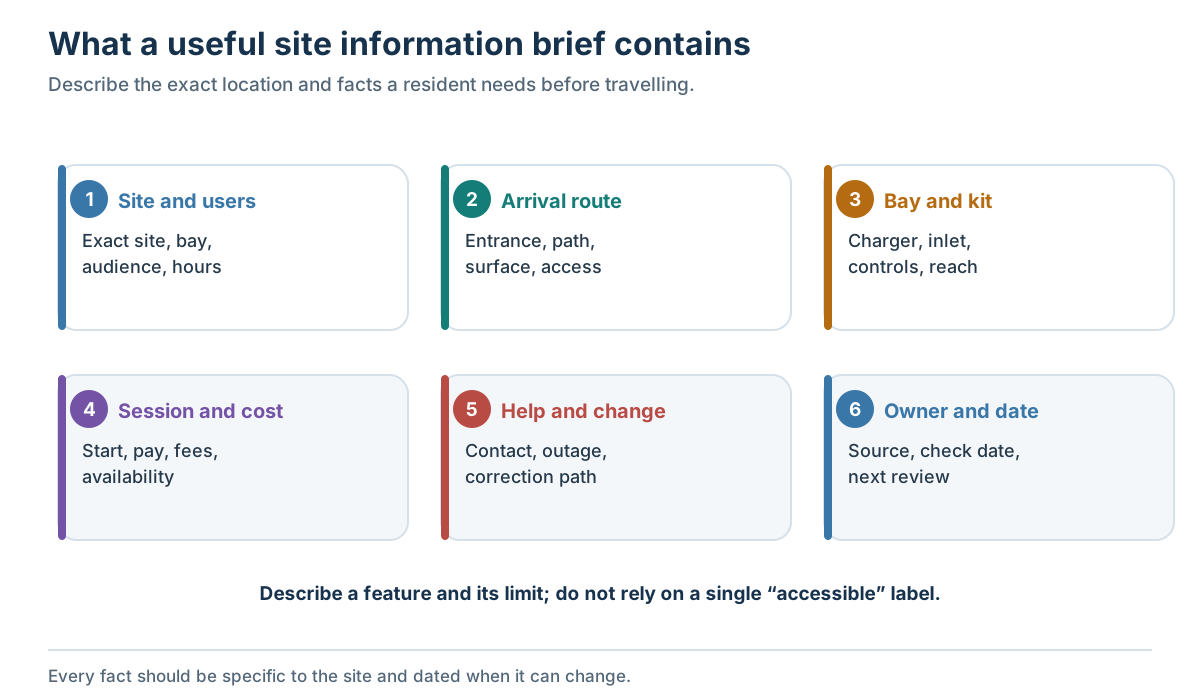
A reusable site information brief
Copy these prompts for each site or charging area. Identify the exact bay and charger rather than writing about a whole building as if every location were the same.
- Site and charger: Give the site name and address, entrance or gate to use, charger and bay identifiers, operator, and who may use the location. State opening hours, visitor rules, resident or public priority periods, booking or permit conditions, parking charges, and restrictions that affect access.
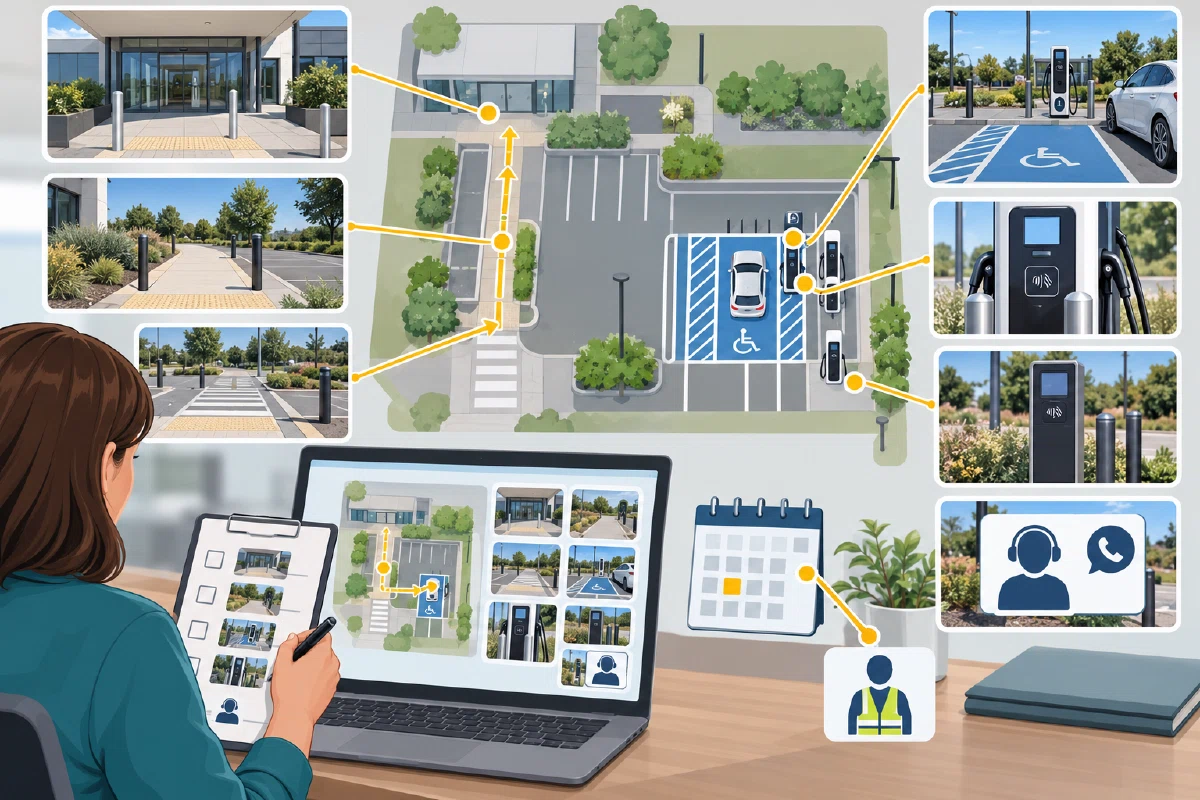
- Arrival and route: Describe how to reach the charger from the entrance, accessible parking, or public path. Note observed doors, lifts, kerbs, slopes, surface changes, crossings, lighting, or obstructions that may affect the route. Say when the route was checked and identify temporary construction or seasonal conditions. Do not turn a brief description into a compliance finding.
- Bay and equipment: State where the charger and controls sit in relation to the bay. Identify connector type and cable details using the manufacturer information or a measured site observation; describe how a vehicle’s inlet position may affect reach. Record any access aisle, transfer space, or known obstruction that the user should consider. Avoid promising that one measurement or arrangement fits every vehicle and person.
- Start, stop, and pay: Give clear steps for starting and ending a session. List the methods that actually work at this site, such as an app, card, contactless payment, or another confirmed option. Show the current charging price and any parking, membership, idle, or connection fee, or link directly to a reliable current source. Date price information and say whether availability is live or only current as of the last check.
- Help and disruption: For each assistance task, name who provides it, the working channel and hours, whether advance notice is needed, any limits, and the fallback if help is unavailable. Explain how to report a fault, request information in another format, or correct a site detail. A general enquiry number is not proof of an available assistance service; do not promise on-site or continuous help unless the operator confirms it.
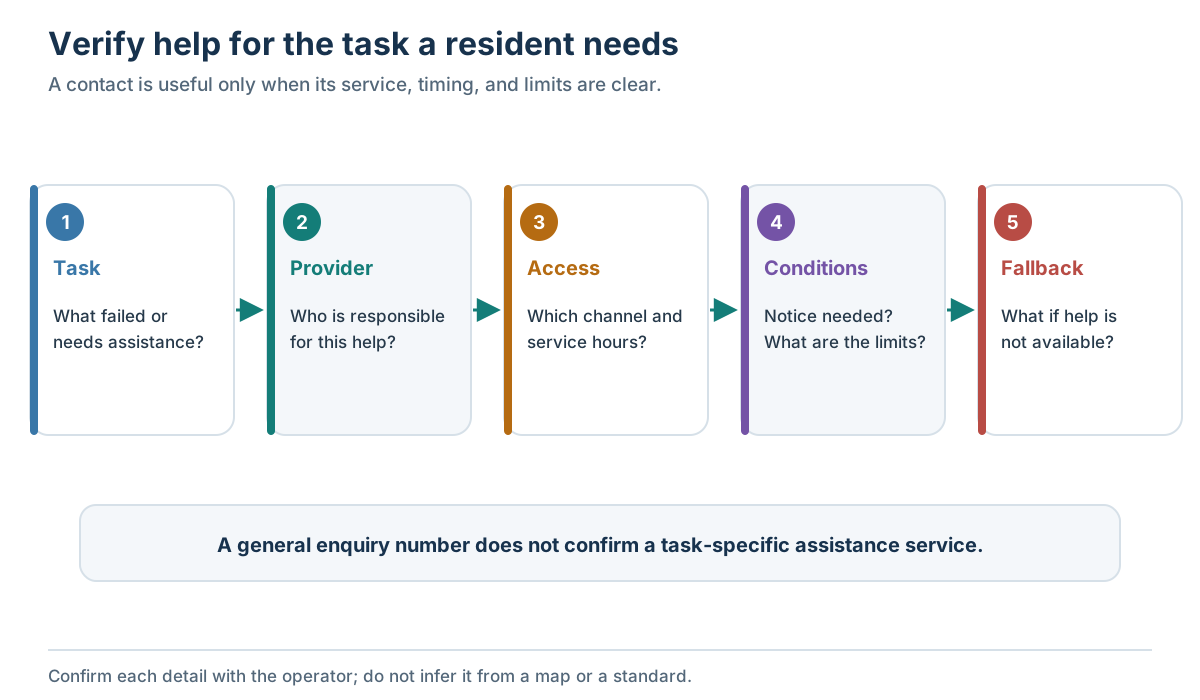
- Images and diagrams: Include dated views that help a person identify the entrance, route, bay, charger, controls, and relevant surrounding space. Add a concise caption and text description for each image. Remove or obscure faces, license plates, access codes, and other personal details unless there is a clear, authorized reason to show them. A photo can help someone assess a feature, but it cannot prove that the route or charger is usable for them today.
Label what is known
For each important statement, say what kind of information it is:
- Observed: someone checked a feature at the site on a named date and under stated conditions.
- Measured: give the value, place measured, method, and date. A measurement alone does not determine legal compliance or individual fit.
- Equipment or operator information: name the source, model or service version where relevant, and the date it was confirmed.
- Resident-reported: summarize the experience and the period or feedback method without implying that one person’s experience is universal.
- Planned: describe proposed work as a plan, not as something residents can use now.
- Delayed: say that the expected date has changed and give a new date only if the responsible provider confirms one.
- Terminated: state that the project ended; do not present a proposed site or service as an available fallback.
- Operating: confirm that the service has started, who can use it, and its current hours with the responsible provider.
- Unknown or unverified: say what is missing, who can check it, and when an answer is expected if known.
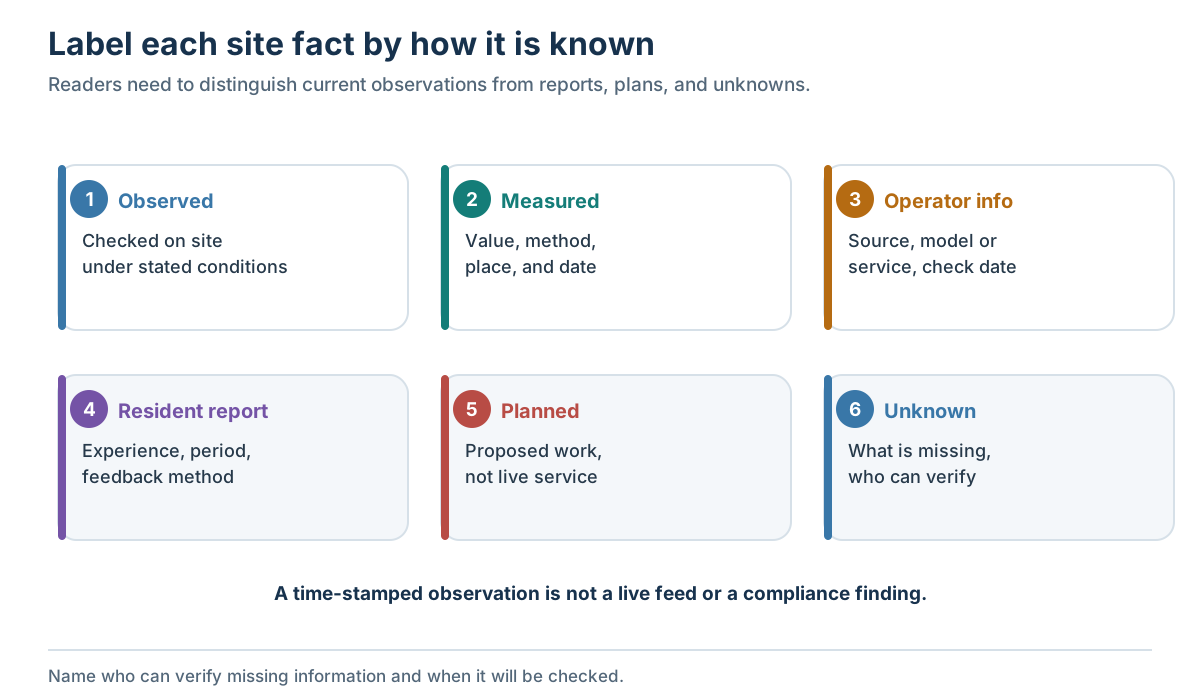
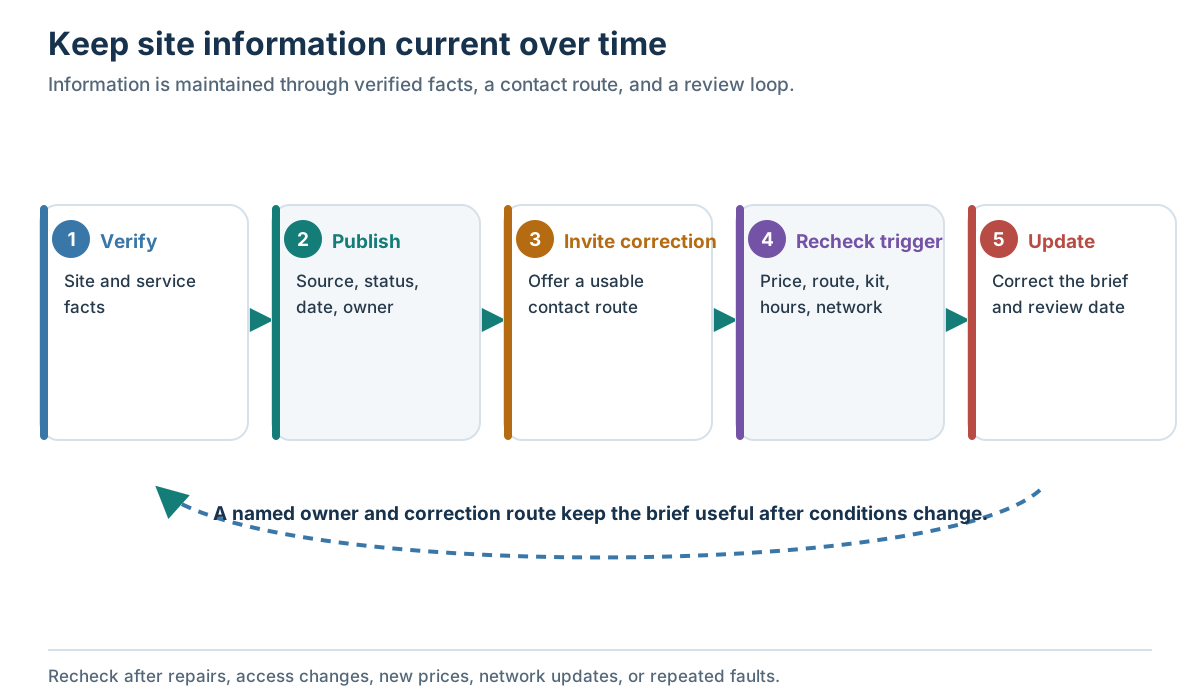
Finish the brief with an information owner, site-check date, next review date, correction contact, and links to any live price or availability information. A time-stamped observation is not a live feed. If a feature cannot be confirmed, publish it as unknown instead of filling the gap with a broad accessibility score or assumption.
Verify the brief before publishing
- Start with a site walk-through that follows the full journey from arrival through payment, help, and exit. The accessibility walk-through guide can help turn observations into a task-based record.
- Confirm equipment details with the installer or manufacturer, then check operating hours, access conditions, payment, prices, and support with the building or charging operator. For assistance, confirm the supported task, channel, hours, advance notice, limits, and fallback; distinguish a general contact from a promised or tested service. Keep site observations separate from service promises and equipment specifications.
- Ask residents and visitors with different access needs whether the description answers the questions they would need before a trip. Offer a way to comment without requiring someone to disclose a diagnosis or financial details. Follow the accessibility and privacy rules that apply locally.
- Publish the same core facts through the channels residents actually use, with readable text and image descriptions. Where an alternate format or contact route is offered, state what it is and how to request it. Do not assume a mobile app, hotline, or on-site helper works for everyone; verify each one.
- Name an owner and set review triggers. Check the brief after equipment repair or replacement, changes to parking rules or access hours, resurfacing or construction, network or payment changes, a new price, recurring faults, or reports that the description is wrong.
Local laws, building obligations, and data-sharing rules vary. For example, California has specific data-sharing requirements for some publicly available, publicly funded chargers, but those rules do not make every private residential charger part of the same reporting system. Check the relevant authority and service terms before describing an obligation. A map, published photo, grant award, or accessibility label is not a site inspection or an assurance of current access.
The UK’s DfT July 2026 statistics distinguish public chargers from semi-public devices with access restrictions, report a correction after private-access chargers were included in an operator’s public feed, and explain that the series changed from counting “charging devices” to counting chargers in 2026. These aggregate classifications and totals do not establish access to a specific bay. When a map or feed conflicts with the site operator or a dated observation, mark the fact unresolved and confirm it with the responsible provider.
Questions to ask before travelling
Before relying on a charger, ask the provider or operator:
- Which exact bay and charger can I use, and when can I enter the site?
- What route leads to it, and are there current photos or a diagram showing the route and surrounding space?
- Will the connector and cable work with my vehicle and the way I need to approach or leave it?
- Can I start, stop, and pay using a method I can use at that location? What is the full current cost?
- What assistance can the provider give for the task I need, through which channel and hours, with what advance notice or limits, and what is the fallback if it is unavailable?
- When was this information last checked, and how can I report a missing or incorrect detail?
If an essential answer is unknown, ask the site owner or operator to confirm it before depending on the trip. If the facts remain uncertain or do not fit your needs, compare another route using the no-smartphone and no-private-parking guide or ask the housing provider what can change. For resident costs and service outcomes, see EV charging equity in affordable and social housing. For a landlord preparing a building-level installation, see the residential landlord grant guide.
Information checked 9 November 2026. Confirm site access, prices, availability, assistance, and local requirements directly before making a journey or building decision.