Tennessee Public Chapter 914 gives qualifying condominium and homeowners’ association owners a route for a personal-use charger on their property or designated parking. It took effect July 1, 2026, and applies to actions taken and declarations entered, renewed, or amended on or after that date. Check the association type, parking record, and relevant declaration or action before relying on it.
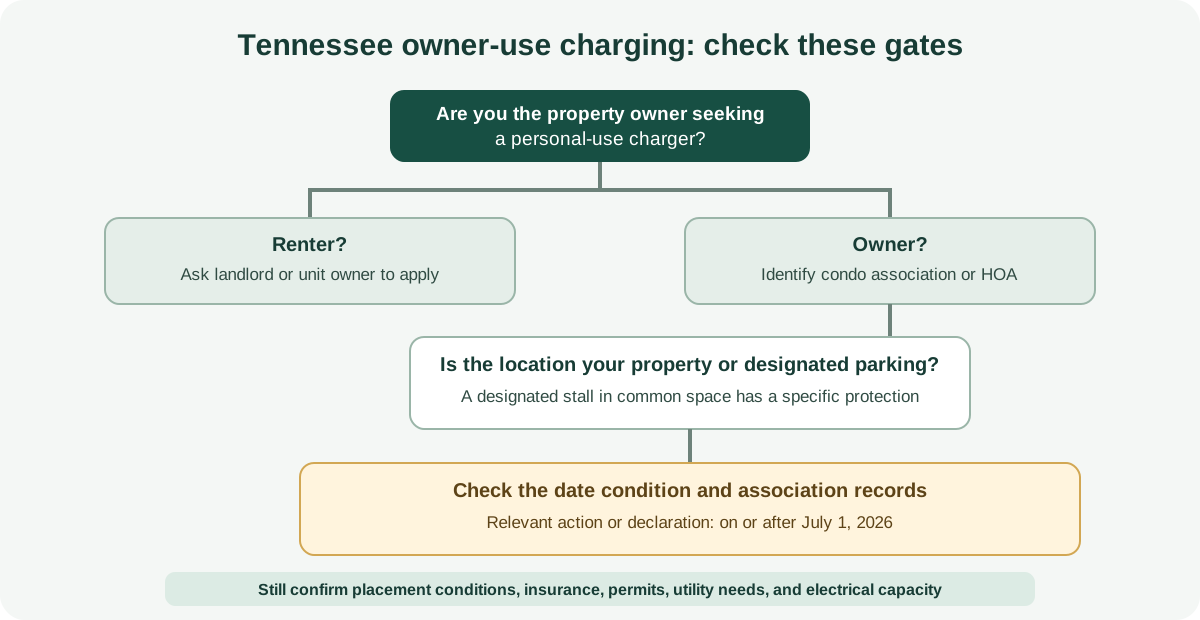
Check the property and parking
For a condominium, the enrolled Act protects a unit owner’s personal-use charger on the owner’s property, including designated parking. For an HOA, it protects an owner installing on the owner’s property, including designated parking. Both associations may set reasonable limits on the number, size, placement, and installation of a charger on the exterior of that property.
A designated parking location within a common element or common area receives specific protection: the association may not prohibit a charger there. The association may generally prohibit or restrict chargers elsewhere in common elements or common areas. An unassigned or visitor stall is not automatically your designated location. The Act does not create a separate renter installation path.
Prepare a written request
- Confirm whether the community is a condominium association or an HOA, and identify the owner of the home and parking space.
- Check the deed, declaration, parking assignment, and relevant association action date. The Act’s date rule can depend on when an action occurred or a declaration was entered, renewed, or amended.
- Give the association a proposed location, equipment details, and a preliminary route prepared with a qualified local electrical professional. Ask which reasonable placement or installation conditions apply.
- Put responsibility for installation, maintenance, insurance, damage, electricity, and removal in writing. The owner is responsible for maintaining the charger and must indemnify the association; the association may require insurance naming it as an insured.
- Confirm permits, inspections, utility requirements, and electrical capacity separately. The Act does not approve a design or authorize work that needs other approval.
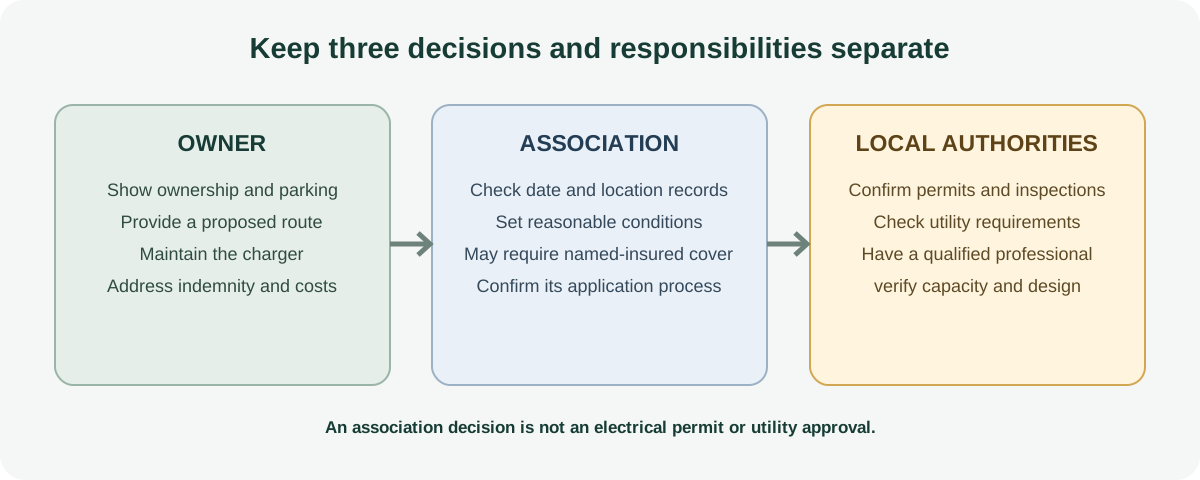
The Tennessee General Assembly’s status page identifies Public Chapter 914 and an effective date of July 1, 2026; its summary describes the owner-use provisions above. The Secretary of State chapter PDF could not be opened during this check, and the current Tennessee Code consolidation was not independently verified. Confirm the current text of T.C.A. §§ 66-27-901–902 and the relevant association documents before relying on a disputed condition. The available status and legislative text do not set a request-response deadline. Do not borrow one from another state’s law. If the association type, stall designation, or date condition is disputed, ask the association to identify the records it relies on and get Tennessee legal advice before proceeding. Renters should start with their landlord or unit owner, who can identify any association process. For a board-ready project packet, see the condo and HOA proposal guide; for other local approvals, use the address-level rules workflow.