Utah has different EV charging provisions for condominium owners and owners in planned communities. First identify the legal form of the association and the parking interest shown in your recorded documents. These rules address owner-installed personal charging in specific spaces; they do not give a renter or an owner of an unassigned stall a general right to install a charger in shared parking.
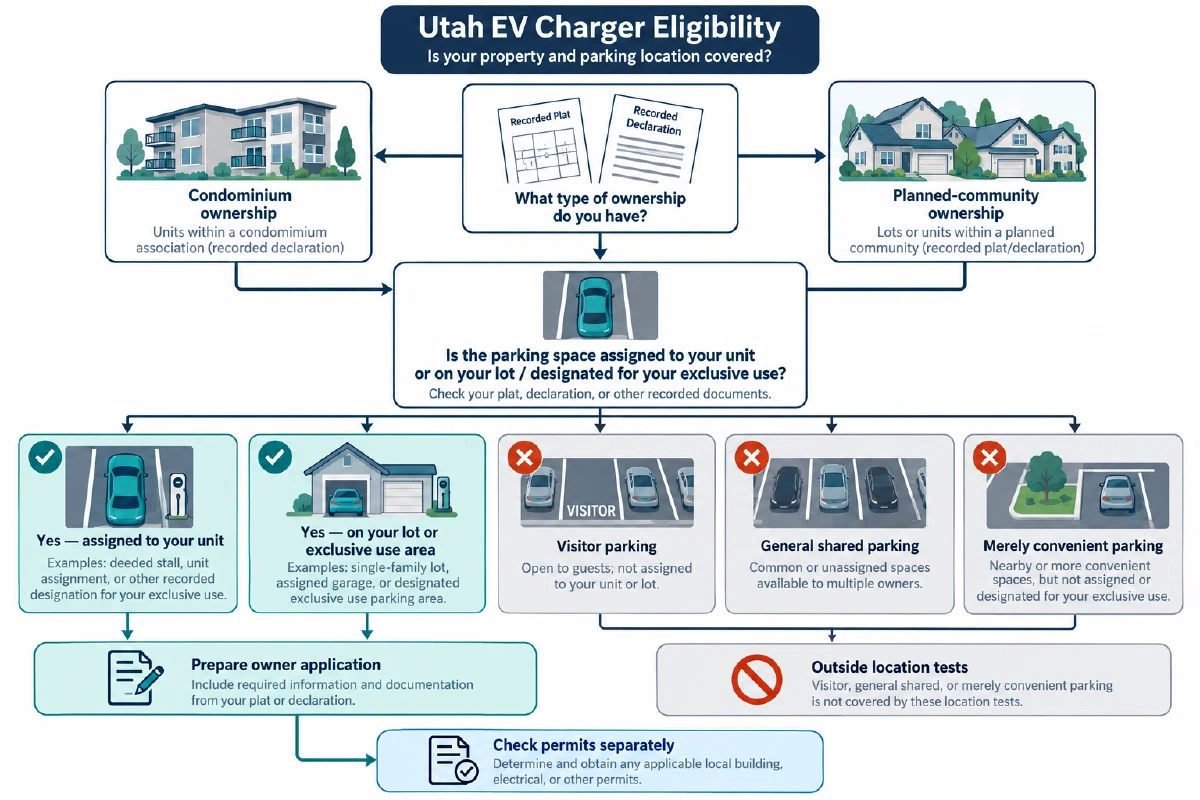
Choose the parking test
For a condominium, Utah Code § 57-8-8.2 protects a charging system in the unit or a parking space assigned to that unit for parking or storage, including a limited common-area space designated for the owner’s exclusive use. For a planned community, § 57-8a-802 covers a parking space on the owner’s lot or a limited common-area parking space designated for that owner’s exclusive use. A general common lot, visitor stall, or space that is merely convenient is outside these location tests.
Pull the recorded declaration and condominium plat or planned-community map. Match the stall number and cable route to the unit or lot. If the documents do not clearly show whether the space is assigned or exclusive-use, ask the association to identify the record it relies on before you submit a design.
What the association may require
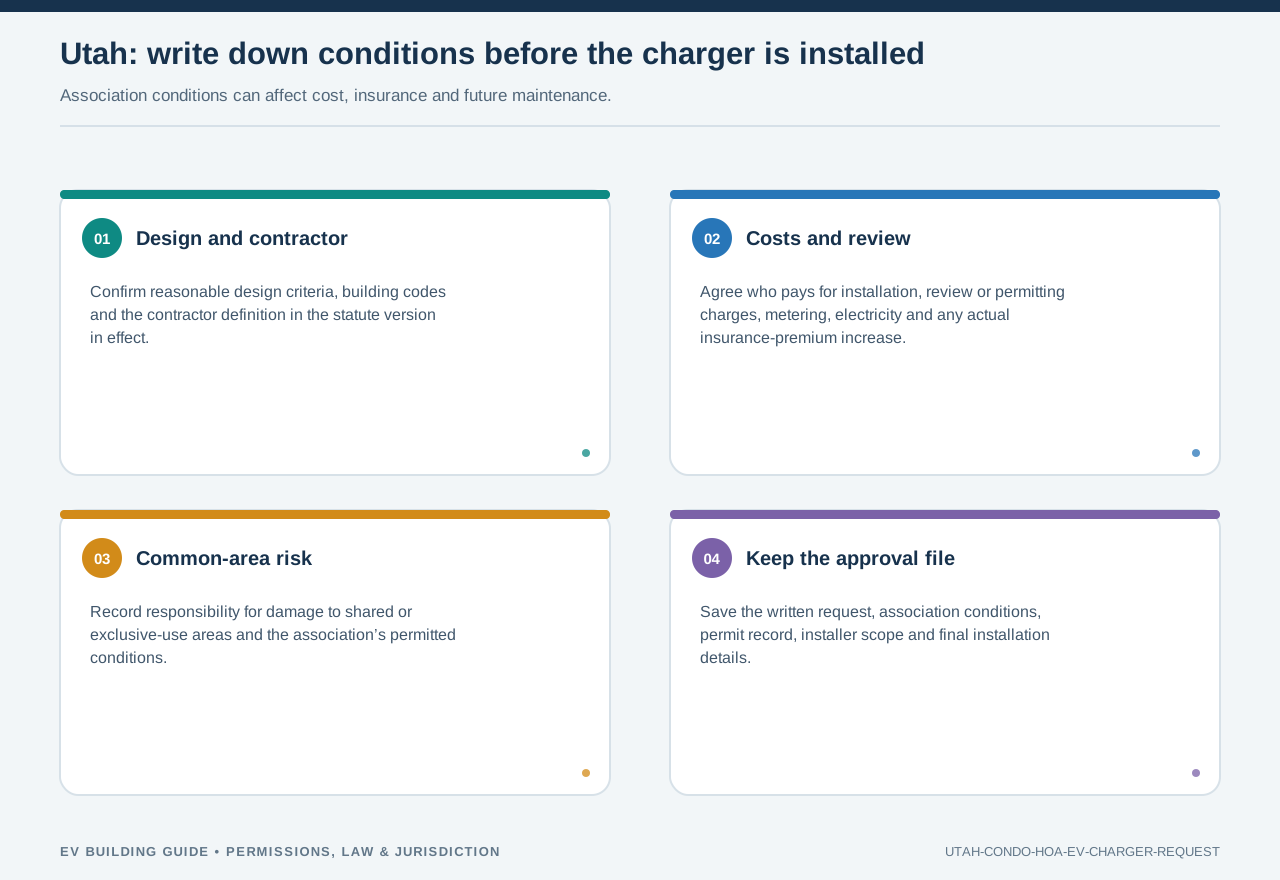
The association cannot prohibit a qualifying owner installation, but it may require an application and reasonable conditions. Utah’s HOA Ombudsman guidance says an association may require a written agreement to use a general or residential electrical contractor, follow reasonable design criteria and building codes, and pay a reasonable review or permitting charge. If equipment is installed in a common area, the owner may also have to reimburse the actual increase in the association’s insurance premium attributable to the installation or use.
Restrictions on placement or design may not significantly increase the installation cost or significantly reduce charging efficiency or performance. Get a contractor estimate that compares the requested alternative with the proposed design if a condition appears to change either measure substantially. The association may require the owner to pay installation, metering, electricity, and damage costs, including damage to certain shared or exclusive-use areas.
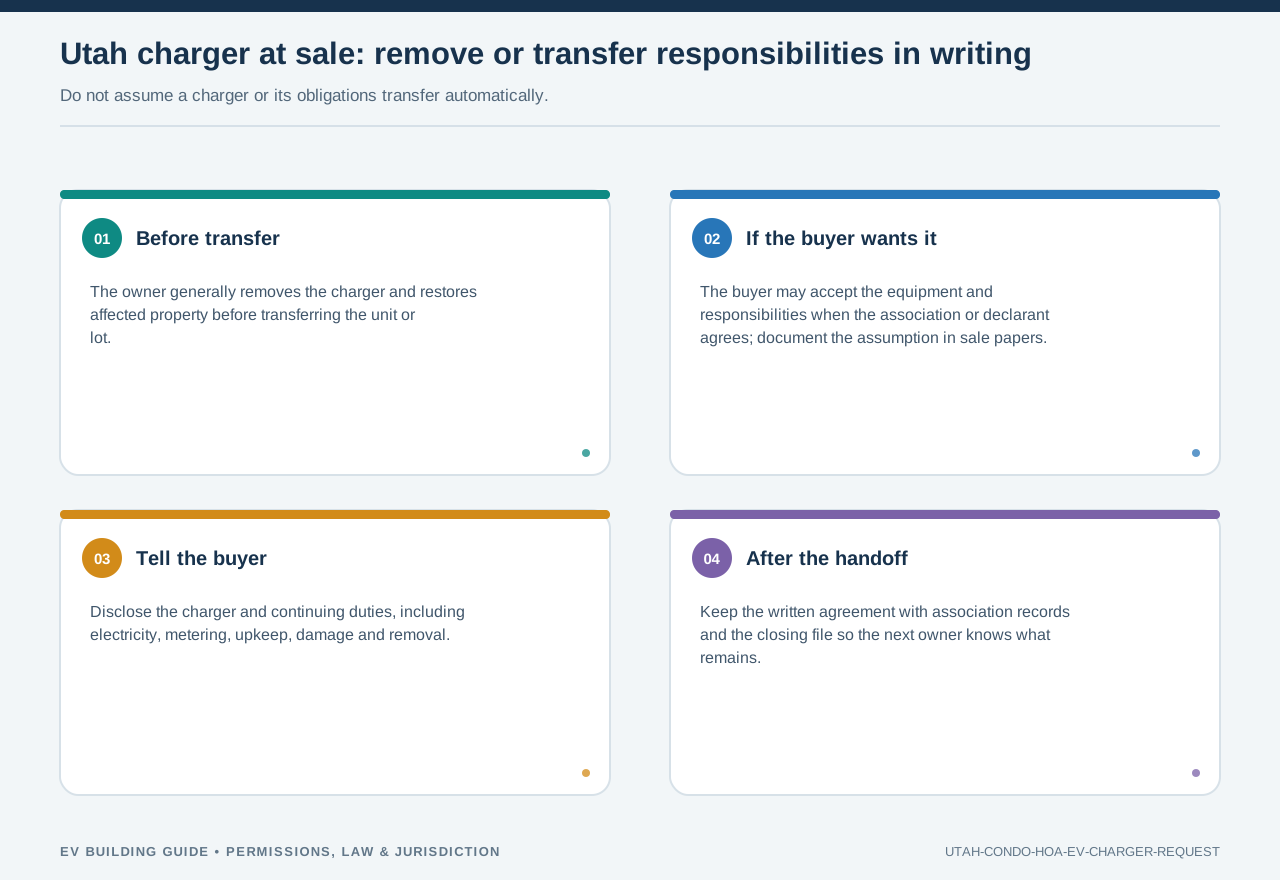
The owner must disclose the charger and related responsibilities to a prospective buyer. Unless the association or declarant agrees otherwise, the owner generally removes the equipment and restores affected property before transferring the unit or lot. A buyer can accept the charger and its responsibilities, but record that agreement in the sale documents rather than assuming the equipment and duties transfer automatically.
The Utah Legislature’s current-and-future Part 8 text shows a scheduled January 1, 2027 change to both planned-community contractor definitions in § 57-8a-801: the cross-reference moves from § 58-55-102 to § 58-55-202. For work on or after that date, check the operative code version and contractor license class. The condominium branch has its own code version, so verify that branch separately.
Submit a decision-ready request
- State whether the property is a condominium unit or a planned-community lot and identify the matching statute.
- Attach the recorded parking designation, a location drawing, the wiring route, equipment information, and any proposed common-area work.
- Ask a qualified electrician to assess capacity, service or panel needs, metering, code requirements, and a safe installation method.
- List who will pay for installation, electricity, metering, insurance increases, maintenance, damage, and removal. Ask for the association’s written conditions and response.
- Obtain required local permits and utility approvals separately. Association approval does not confirm available capacity or authorize electrical work.
The official Utah Ombudsman pages explain the two branches and link to their statutes, but your declaration, stall assignment, and site conditions control the practical answer. Get Utah legal advice if the community type, location test, or a proposed restriction is disputed. For a complete board packet, use the condo proposal guide; for local permits and utility checks, follow the address-level workflow.