Vermont’s EV supply equipment (EVSE) rule is in 27A V.S.A. § 3-125, added by Act 168 and effective July 1, 2026. The state-hosted Vermont Statutes Online full-chapter pages now include the 2026 session and display the new section; the site describes its statutory text as an unofficial convenience copy. Before relying on the owner-request protections, identify when the common-interest community was created, how many residential units it has, its legal type, any declaration election, and which parking area you use.
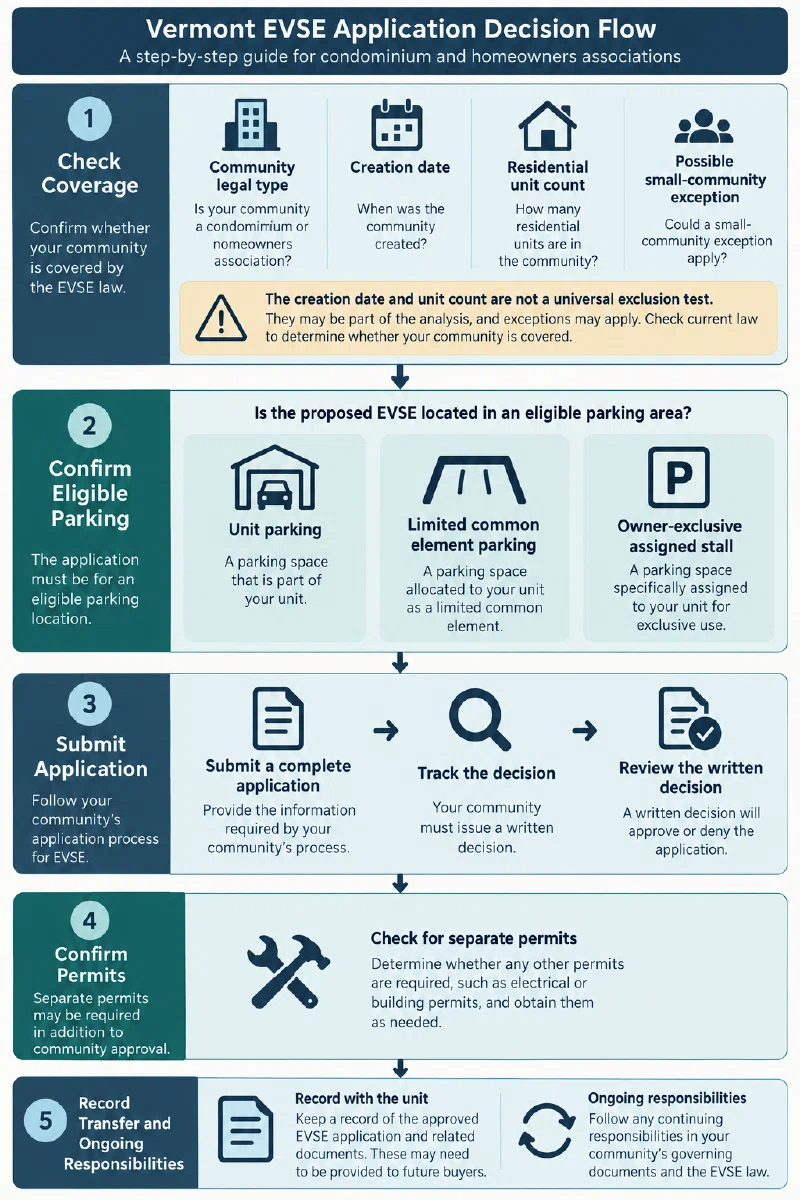
Check whether the community is covered
Section 1-201 generally applies Title 27A to residential condominiums created after January 1, 1999 and to other common-interest communities with at least 12 residential-capable units created after that date, subject to §§ 1-203 and 1-204. Section 1-204(3) extends § 3-125 to communities with at least 12 residential-capable units created on or before January 1, 2011, for events after June 30, 2026. That extension is subject to § 1-203 and does not invalidate existing declarations, bylaws, plats, or plans.
Check the exceptions before treating those dates and unit counts as an automatic answer. Under § 1-203, a planned community with no more than 24 units and no development rights, or a qualifying limited-expense planned community, may be subject only to specified provisions unless its declaration makes all of Title 27A applicable. Section 1-204(b) has an additional rule for some pre-1999 planned communities with no more than 24 units and no development rights. Nonresidential or mixed-use communities can also depend on declaration terms under § 1-207. Ask the association for its creation date, residential-unit count, legal type, development-rights status, and any declaration election or amendment; consult Vermont counsel if the coverage test is unclear.
Check the parking and proposed use
For a covered community, § 3-125 protects installation in the boundaries of the owner’s unit, a limited common element, or the owner’s exclusively designated parking space. It also protects noncommercial use by the owner or occupants of that unit. A restriction that effectively prohibits or unreasonably limits qualifying installation or use is unenforceable, while reasonable restrictions remain.
The association may require compliance with health, safety, and building rules; reasonable architectural standards that do not prohibit installation or substantially increase its cost; and a licensed electrician. If the EVSE is in a common or limited common element, the association may require reimbursement for the actual attributable insurance premium increase within 14 days after its invoice. If the board determines that added electricity use requires infrastructure improvements, it may assess the required costs against units of owners who have installed or will install EVSE.
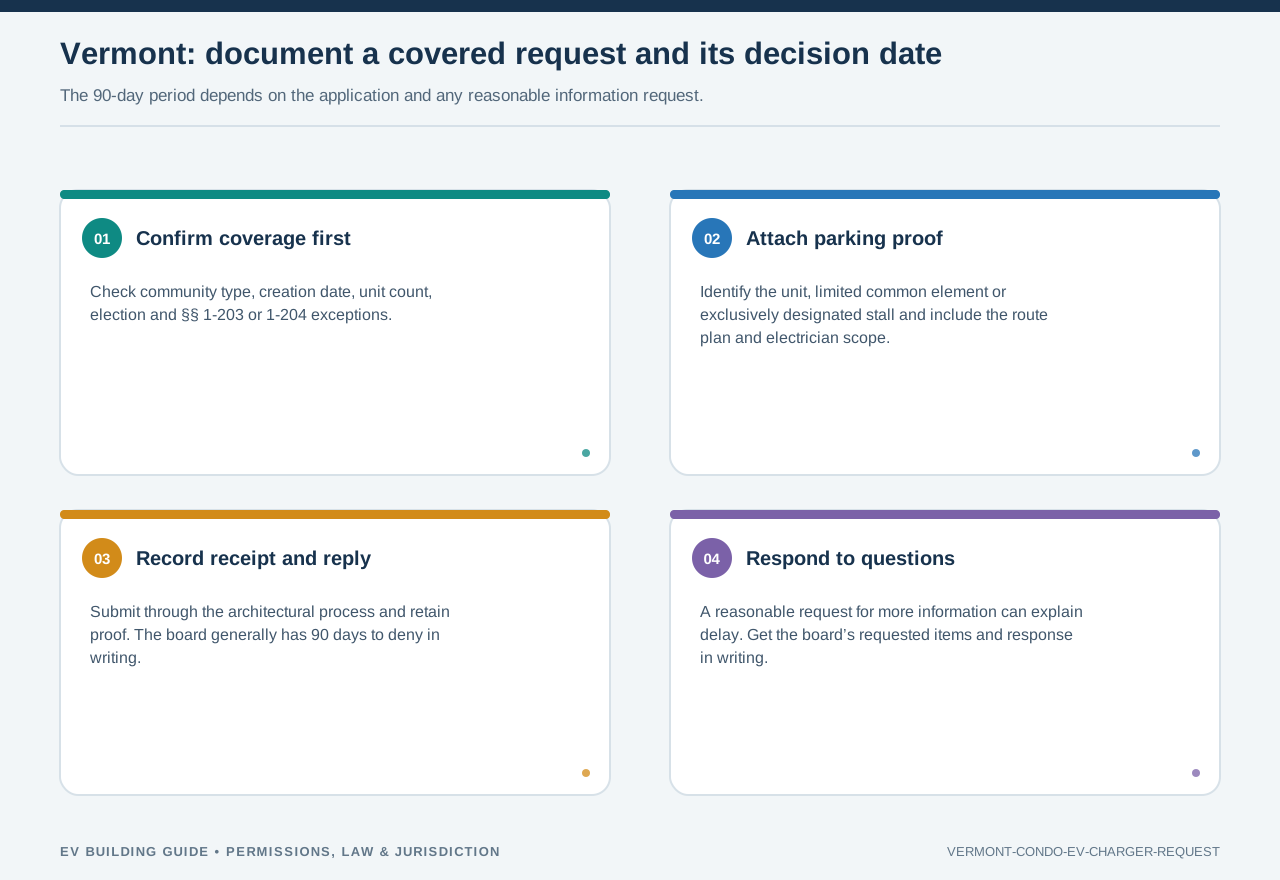
If approval is required, the association must use its architectural-modification process, issue a written approval or denial, and not intentionally delay the request. The application is generally deemed approved if it is not denied in writing within 90 days, unless a reasonable request for more information explains the delay. Keep proof of the complete application and any follow-up request; do not treat the deadline as running through a reasonable information request.
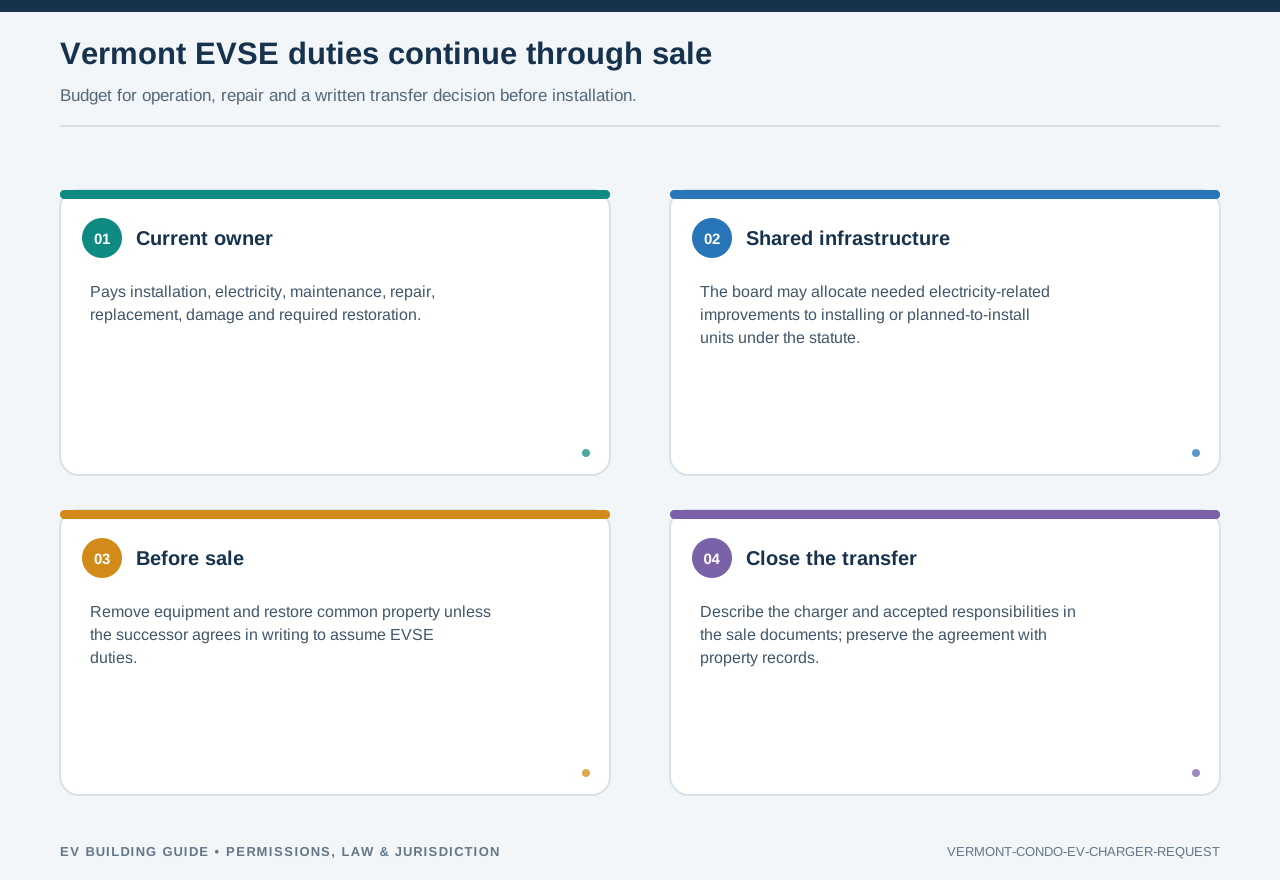
The EVSE owner and successive EVSE owners bear specified damage, installation, maintenance, repair, replacement, electricity, and restoration costs. Before sale, the owner must remove the equipment and restore affected common property unless the successor owner agrees in writing to take on the EVSE responsibilities. Include that decision in the transfer documents.
Prepare the application and stop at unresolved points
- Record the community’s creation date, unit count, legal type, any Title 27A election, and the relevant § 1-203 or § 1-204 exception question.
- Attach the parking assignment, a site plan, the proposed charger and route, and a licensed electrician’s preliminary scope.
- Ask the board to identify its application procedure, written response date, insurance documentation, electricity method, and any proposed shared-capacity improvement assessment.
- Save the submitted application, receipt, written decision, contractor documents, permits, and the cost and sale agreements.
- Confirm municipal permits, inspection, utility capacity, and electrical-code requirements separately before work begins.
This guide does not determine whether a particular declaration or community is covered. Pause if the community’s creation date, unit count, parking interest, or exception cannot be confirmed. For a proposal structure, see the condo, HOA, or strata guide; use the local rules workflow for permits and utility approvals.