This guide is for owners and managers coordinating professional fire-risk governance for a covered car park in England. It is not a fire-engineering design, a finding that a particular garage is safe, or an emergency procedure. Confirm the site’s classification, responsible person, applicable requirements, and actions with qualified local professionals.
Status checked 29 October 2026: the GOV.UK EV guidance remains interim and was last updated on 8 February 2024. A government consultation opened on 21 October 2026 and asks about extending chargepoint installation requirements to new or substantially renovated covered car parks and about the interim guidance. Responses are due by 11:59 p.m. on 16 December 2026. These are proposals and questions; they have not changed the current requirements or the guidance.
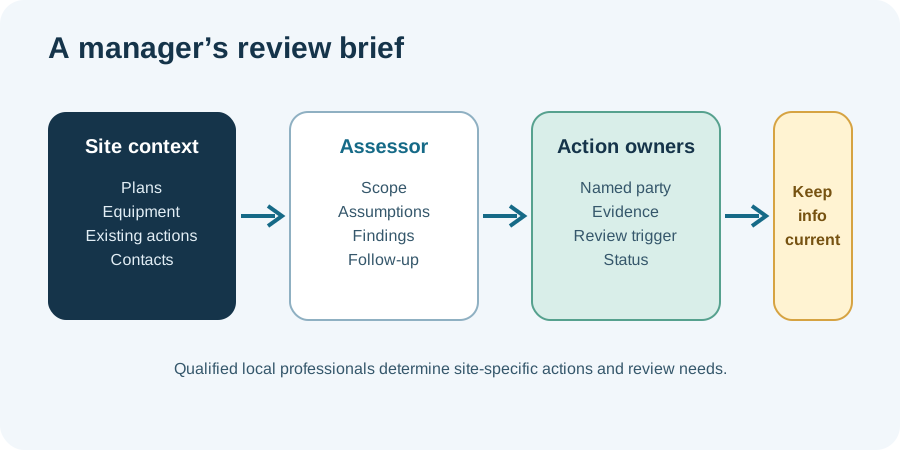
Prepare a site-specific review brief
First confirm that the car park and work fall within the England covered-car-park guidance. Identify the building and car-park owners, managing agent, charging operator, and the statutory fire-safety responsible person or persons. Their roles depend on the premises and actual control; a service contract alone does not determine who holds a legal duty.
Give the assessor current plans and information about parking levels, escape routes, chargepoint locations and type, access controls, the building’s fire strategy, maintenance and fault records, and any previous assessment actions. Ask the competent assessor to state the assumptions and scope, record findings, identify who owns each action, specify what evidence closes it, and name the professional or authority needed for follow-up. The responsible person remains accountable for ensuring the site has a suitable and sufficient fire-risk assessment.
The interim guide includes examples that are not a universal inspection schedule. Set review triggers with the assessor for material changes to the layout, charging equipment, vehicle use, fire strategy, or management. Do not invent a fixed inspection interval, spacing rule, mitigation design, or assurance that a completed checklist proves compliance.
Keep resident and responsible-person information current
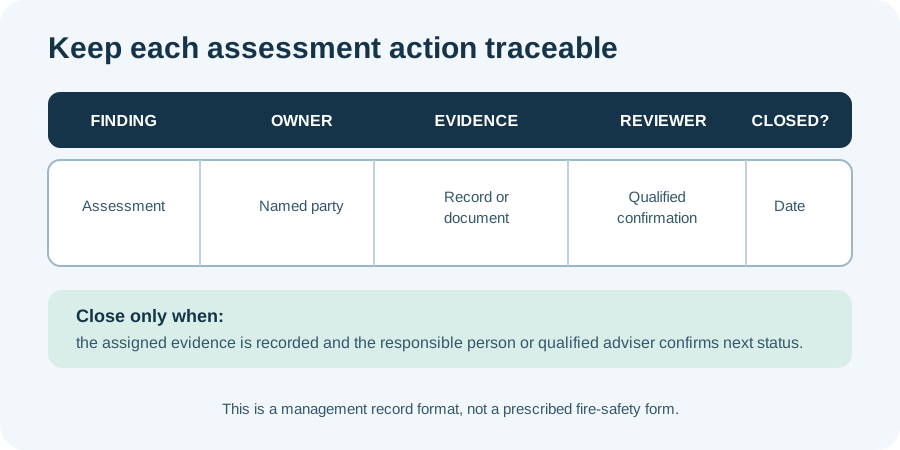
For premises covered by the Fire Safety Order, the responsible person must keep the fire-risk assessment and fire-safety arrangements recorded, coordinate with other responsible persons, and share relevant information when the responsible person changes. The Fire Safety (England) Regulations 2022 also require specified buildings with two or more domestic premises and shared escape routes to display understandable fire instructions. Those instructions cover the building evacuation strategy, how to report a fire, and what residents should do after a fire; the responsible person must provide them to new residents, all residents during each 12-month period, and again after material changes.
These are building fire-safety instructions, not EV charger shutdown or battery-response steps. Coordinate emergency information with the responsible person, competent fire professional, and local fire and rescue authority. Keep the current contact, approved resident instructions, assessment, action owners, and evidence together so an incoming manager can identify what remains open. For an active emergency, follow the building’s approved emergency arrangements and contact emergency services; leave electrical intervention and fire response to qualified responders.
The routine charger-support guide covers equipment faults, while the service handover guide covers broader operating responsibilities. Building regulation and installation decisions sit with the relevant building-control and electrical professionals.