An electric vehicle that charges normally is not automatically able to power a home, shared building, or grid. Before buying equipment or promising backup, verify the exact vehicle and software, the complete manufacturer-approved bidirectional equipment set, the intended direction and use, and the apartment site’s authority and utility conditions. If any part of that chain is undocumented, record it as unknown and pause the plan.
Updated: 9 November 2026. Confirm current vehicle, equipment, program, and site requirements before relying on a backup or export feature.
The energy direction determines the question
“Bidirectional” covers different jobs. A vehicle-to-load (V2L) outlet or accessory can power compatible portable devices within the maker’s stated limits. It does not show that the vehicle can feed a building circuit. Vehicle-to-home (V2H) or vehicle-to-building (V2B) supplies a home or selected building loads through a supported system. Vehicle-to-grid (V2G) exports energy or grid services through an approved interconnection. These modes require different equipment and permissions; a label for one mode is not proof of another.
| Intended mode | What receives the energy | What to confirm |
|---|---|---|
| V2L | A device or portable load connected through the vehicle’s approved outlet or accessory | Exact vehicle/adapter support, permitted load and use conditions. Do not connect a portable output to apartment wiring. |
| V2H / V2B | A home or selected building loads | The exact vehicle and bidirectional system, transfer and protection equipment, supported loads, and whether outage backup is included. |
| V2G | The electric grid or a grid service | All vehicle and equipment requirements plus the serving utility’s current interconnection and export acceptance for that site. |
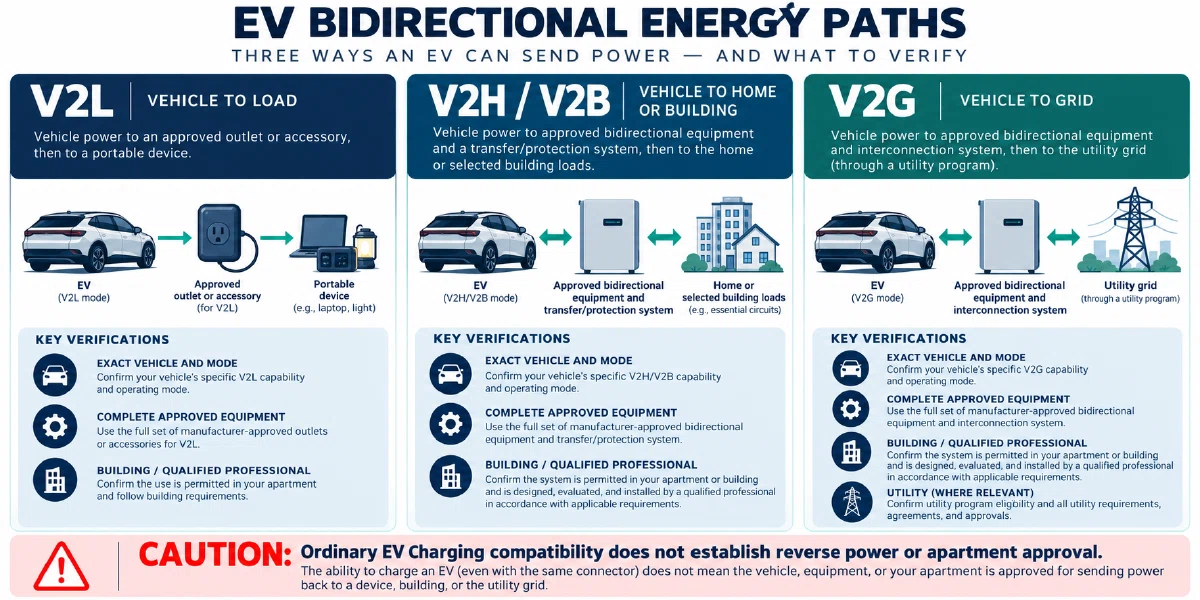
DOE’s Federal Energy Management Program describes a bidirectional EV as able to receive energy from charging equipment and provide energy to an external load. Its guidance distinguishes supplying a building or selected loads from providing grid services, and notes that export needs an interconnection arrangement that permits reverse power flow. The guidance explains the dependencies; it does not approve a particular apartment or give a complete compatible-product list.
Verify a complete, exact configuration
Use the vehicle’s current owner information and the equipment maker’s compatibility documents. Record each answer against the vehicle identification or exact trim, model year, market, installed option, and current software—not just the brand name.
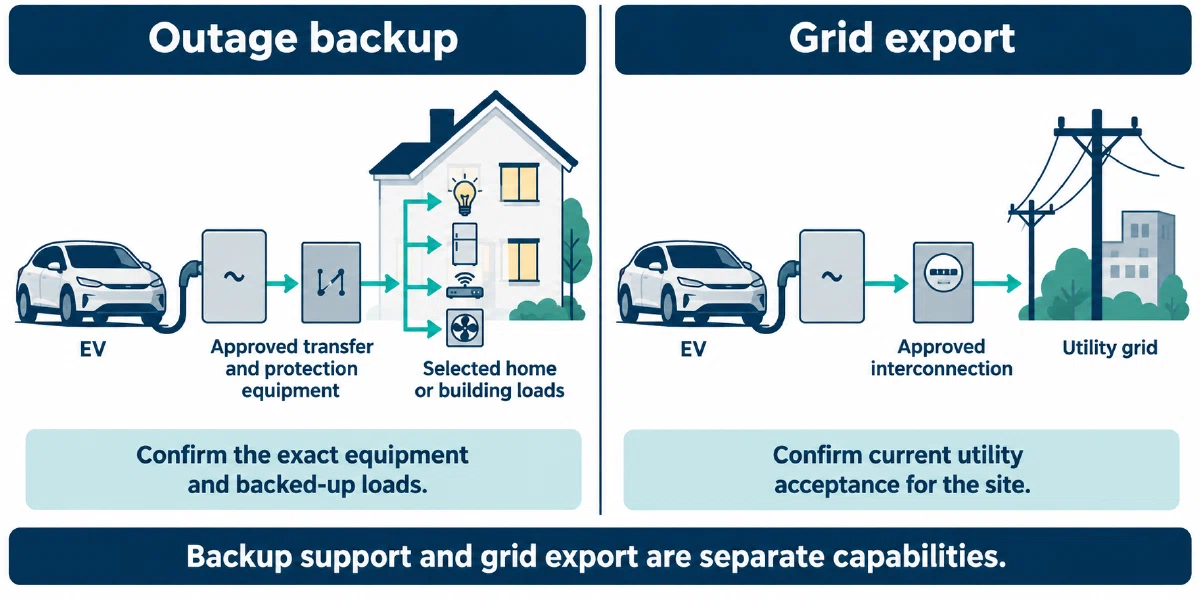
- Name the mode and outcome. Is the goal portable V2L use, powering selected loads at home or in the building, backup during an outage, or grid export? Backup and grid export are separate capabilities to verify.
- Check the vehicle. Confirm the exact model, year, trim, market, optional onboard equipment, software, enabled feature, and stated operating limits. Ordinary AC or DC charging support does not establish reverse-power capability.
- Check the whole equipment set. Ask the vehicle and equipment makers for the approved EVSE or charger, inverter, transfer and protection equipment, controller or home energy management system, storage dependencies, and any registration, pairing, network, or activation steps. Confirm which components must work together and for which mode.
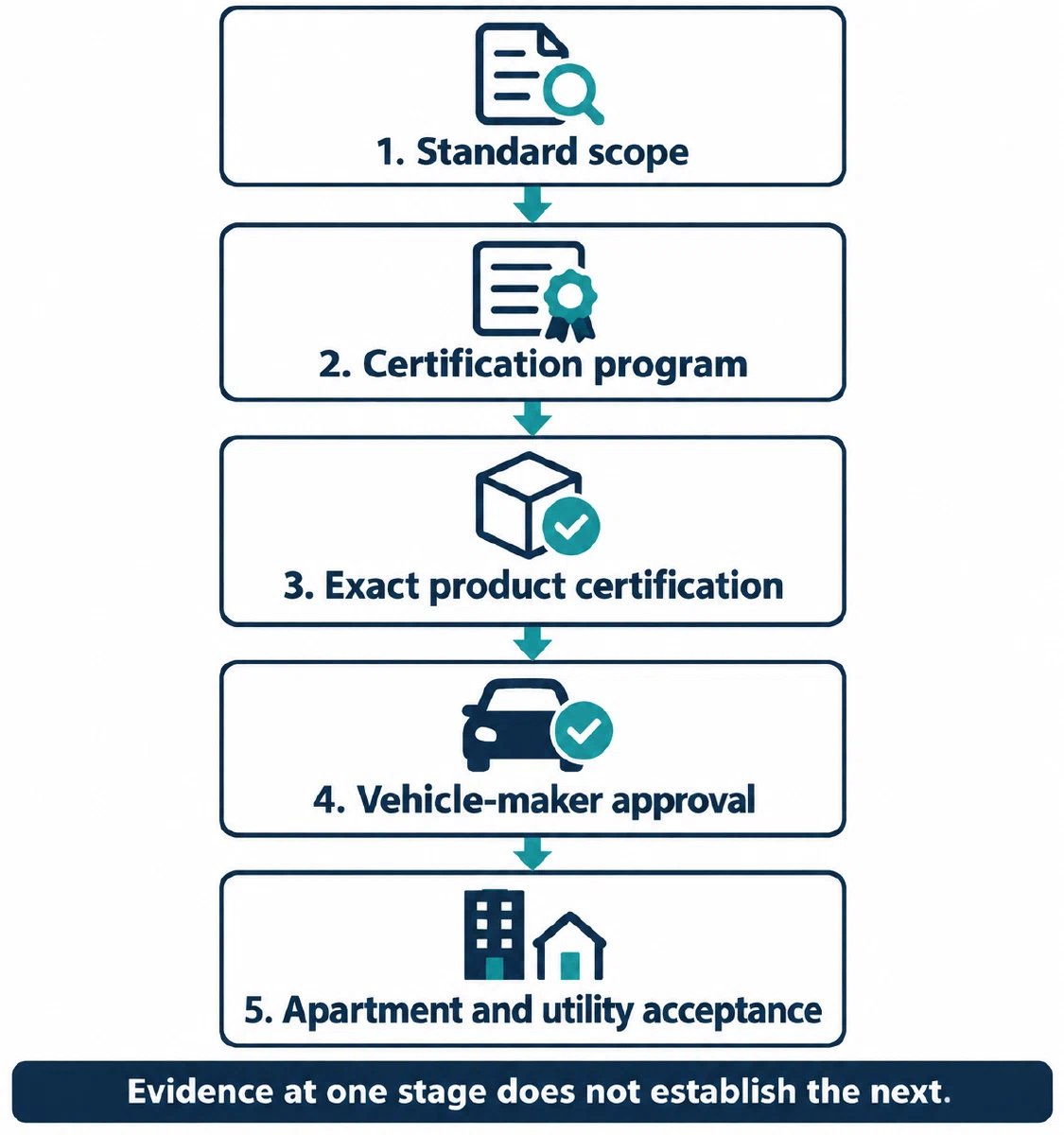
- Check product evidence. Separate a standard’s scope, a certification program, certification of the actual product, manufacturer approval, and evidence that the exact vehicle/equipment pair was tested. One component’s certificate or a compatible connector is not a system result.
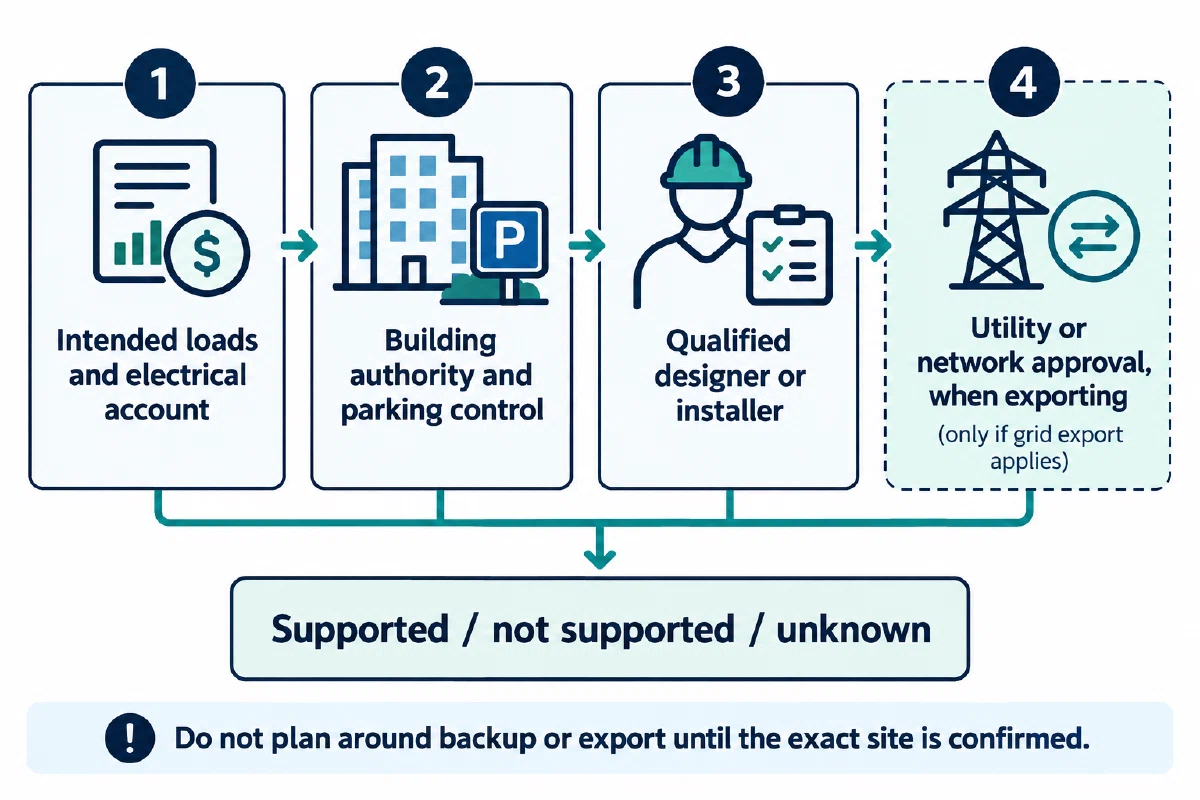
- Check the apartment arrangement. Identify which loads and electrical account would be served, who controls the space and equipment, and who can authorize work on common property. Ask the building, qualified designer/installer, and utility or network operator to resolve meter, protection, commissioning, outage, and export questions for that exact site.
Tesla’s U.S. and Puerto Rico Powershare information is one example of why “bidirectional” is not a universal pairing. For Home Backup with a Powerwall, Tesla lists an eligible vehicle, Powerwall, and Universal Wall Connector or Wall Connector 3; the Powerwall and Wall Connector must be on the same Wi-Fi network and registered and paired at the same site, and Tesla support must enable the feature. Its listed no-Powerwall setup is different: Cybertruck, Powershare Gateway, and Universal Wall Connector. Those are Tesla home configurations, not approval for shared parking, a common meter, or an apartment building. Confirm current eligibility and instructions for the actual vehicle and location.
Market support also needs its own check. Volvo’s EX60 support page says V2H/V2G availability is initially limited to selected markets and requires a Volvo-approved box. Because the page is hosted on Volvo’s Canadian site, that alone does not establish Canadian availability; verify the current country-specific offer with Volvo.
Utility-program eligibility is a separate check from manufacturer compatibility. For its California V2X program, PG&E tells customers to consult an electrician before purchase and select a vehicle and compatible charger from the program’s current eligible-products list. That program-specific direction does not establish apartment, common-meter, or shared-parking eligibility; confirm the current list and site conditions with the program and property.
Certification evidence also has limits. UL Solutions describes a V2G testing and certification program with pathways involving UL 1741 Supplement SC and SAE J3072-compatible onboard inverters, or UL 1741 multipiece DER requirements with UL 9741. That announcement describes program pathways; it does not identify a certified product, prove a tested vehicle/EVSE pair, or establish building or utility acceptance. Ask for the exact product record and the applicable local acceptance evidence.
Record what is supported and what is still unknown
Complete a short compatibility record before budgeting or relying on the feature. Use supported only when current documentation names the exact configuration and mode; mark not supported when the manufacturer excludes it; use unknown when the evidence does not answer the question.
| Check | Status | Evidence or next contact |
|---|---|---|
| Exact vehicle, model year, trim, market, options, and software | Supported / not supported / unknown | Current vehicle manual, build record, or manufacturer feature check |
| Intended mode: V2L, V2H, V2B, backup, or V2G export | Supported / not supported / unknown | Vehicle and bidirectional-equipment documentation for that mode |
| Complete approved component set, activation, and operating limits | Supported / not supported / unknown | Vehicle/equipment makers and the current approved-system list |
| Parking, equipment ownership, electrical account, and loads | Supported / not supported / unknown | Property manager, building owner, condo/strata board, or equipment operator |
| Utility-program vehicle/charger eligibility and enrollment, when applicable | Supported / not supported / unknown | Current program list and administrator; verify property/site eligibility separately |
| Site protection, commissioning, outage operation, and utility export | Supported / not supported / unknown | Qualified local designer/installer and serving utility or network authority |
If any required row is unknown, do not buy equipment or plan around backup or export as though it will work. Ask the organization listed in that row for written, site-specific confirmation. A vehicle outlet, a regular EVSE, an advertised feature, or a general certification statement is not a safe workaround for an unresolved building connection.
For ordinary connector and adapter fit, see EV connector and adapter compatibility. For ordinary AC power limits and EVSE form, see onboard-charger and EVSE power matching and plug-in, hardwired, and smart EVSE. The broader questions belong to building electrical capacity, permission and local rules, installation and commissioning, and energy management and grid interaction.
A portable power station is a separate option for selected device loads during an outage; it does not establish vehicle-to-home or building backup capability. For that separate planning question, see this 24-hour portable power station outage budget.