North Dakota Century Code §47-04.1-16 sets different paths for an owner’s unit or designated parking space, limited common area, and other common area. First check the condominium declaration, plat, and parking records. This guide covers condominium associations under the cited section; it does not establish the same process for tenants, planned-community HOAs, or another state. The official Chapter 47-04.1 text was checked on November 9, 2026.
Identify the space before applying
Find the legal category for the proposed charger location. A unit or designated parking space follows one route. A limited common area requires association approval and written owner commitments. A different common-area location may be available only through a discretionary exclusive-use licence; an association shared station is a separate project.
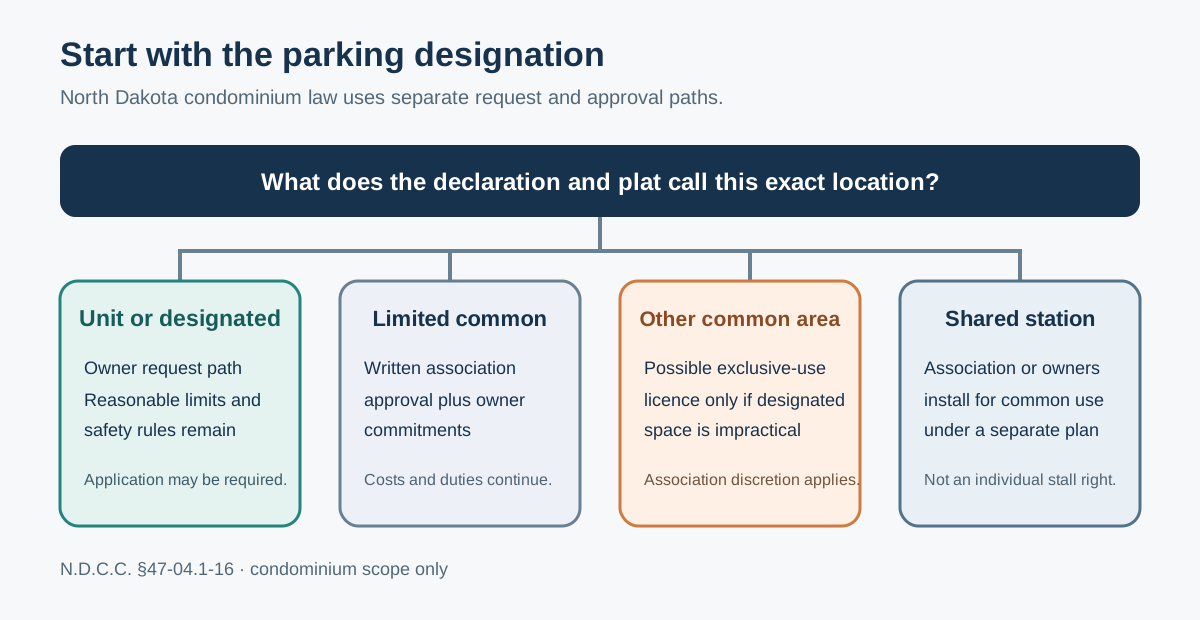
Do not rely only on the stall number or a parking map. Compare the declaration and plat with the association’s current records, and ask the manager to identify any boundary or designation that is unclear. The statute’s owner request rule is not a general right to use any nearby stall.
Submit and track the written application
For an application the condominium’s administrative body requires, send a written request with the owner’s contact details, unit and stall, exact charger location, preliminary route, equipment information, and requested property category. Include any plans, professional assessment, and forms the association reasonably requires. Ask for written confirmation of the date received and save every request for additional information and response.
The statute requires a written decision. If the association does not issue a written denial within 60 days, the application is deemed approved unless a reasonable request for additional information explains the delay. If the association asks for information, record what it needs, when you provide it, and how the request affects the decision schedule. Do not treat this statutory application rule as approval of an electrical design or permission to begin work: permits, inspections, utility steps, and any other property approvals remain separate.
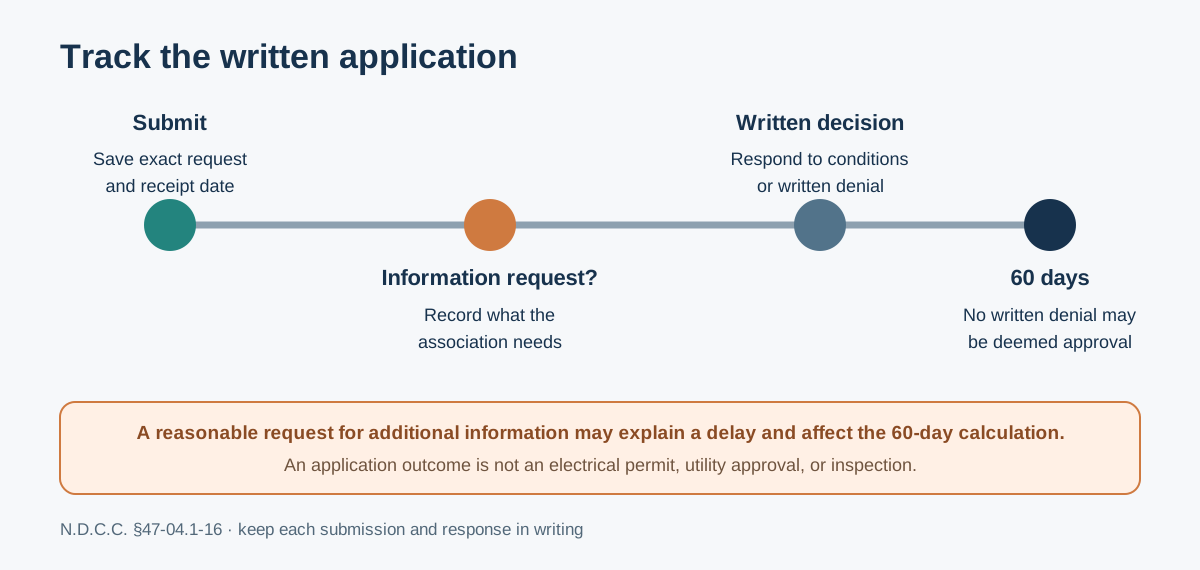
Reasonable restrictions and applicable safety requirements still matter for an installation in a unit or designated parking space. Ask the association to state any placement or safety concern in writing and have a qualified professional address technical issues.
Get approval for a limited-common-area installation
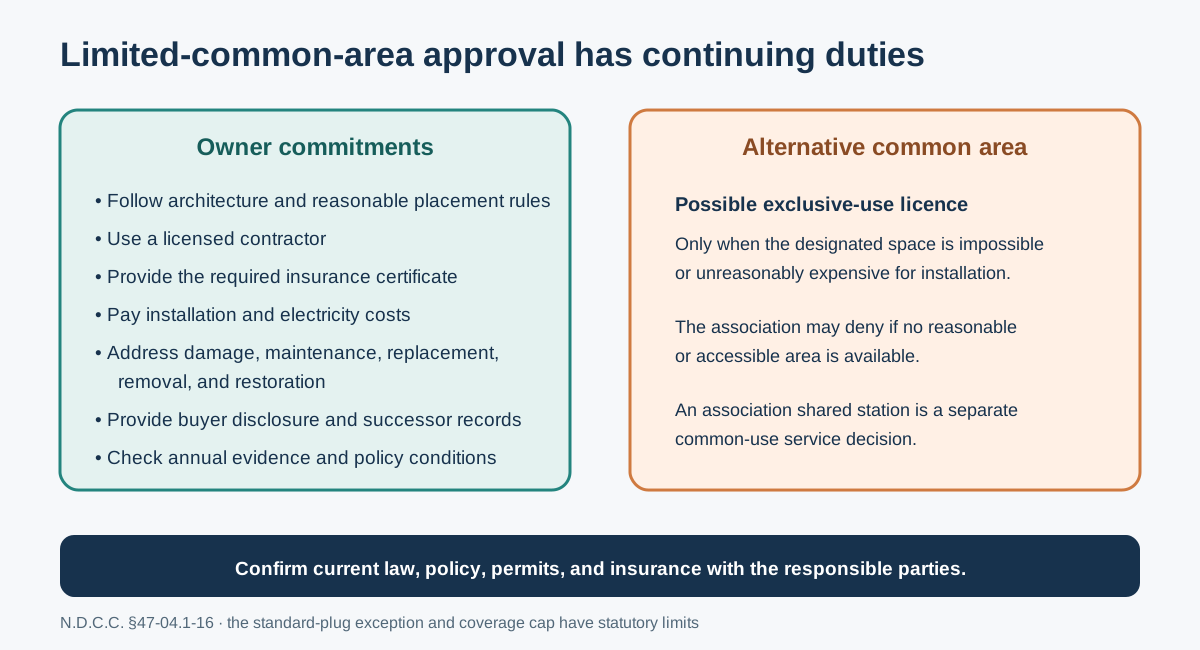
If the proposed charger is in a limited common area, obtain association approval before work. Section 47-04.1-16 directs approval when the owner gives written commitments to meet the statutory conditions. These include following architectural standards and reasonable placement rules, using a licensed contractor, providing the required insurance certificate, and paying for installation and electricity.
The installing owner and successors have continuing responsibilities for damage, maintenance, replacement or removal, restoration, electricity, and disclosure to a buyer. The statute also requires annual insurance evidence in the situations it covers and limits liability coverage to the amount of a typical condominium-owner policy. It includes an exception for an existing standard NEMA AC power plug. Confirm the applicable coverage and any policy wording with the association and insurer before accepting an installation condition.
Treat an alternative common-area location as discretionary
When installation in the owner’s designated space is impossible or unreasonably expensive, the association may grant a licence for exclusive use of another common-area location. This is an option the association can grant, not an automatic right to a nearby space. The association may deny a request if no reasonable or accessible area is available. A station installed by the association or owners for common use is a different shared-charging arrangement.
Before work begins
Keep the declaration and stall records, application, written decision, professional plans, insurance evidence, contractor details, permits, utility responses, inspection records, and final agreement together. Pause if the parking classification or required approval is disputed, if an information request is unresolved, or if the electrical and property routes do not match. Ask a North Dakota attorney, the association, qualified installer, and responsible permit office to resolve their respective questions.
For help assembling a board-ready package, see the condo, HOA, or strata proposal guide. For local permits and utility checks, use the address-level rules workflow. Virginia owners have a different statutory property test; see the Virginia condo and HOA guide.