Virginia has separate EV charging statutes for condominium associations and property owners’ associations (POAs). Start with the community’s legal form and the recorded documents for the unit, lot, and parking space. An assigned stall is not automatically a limited common element or owner-owned property. This guide was checked against the Virginia condominium statute and POA statute on November 9, 2026.
Identify the community and parking interest
Check the deed, condominium declaration, plats, amendments, parking assignment, and association records. Confirm whether the home is a condominium unit or a POA lot, whether the charger is for personal use, and who owns or controls the exact stall and proposed wiring route. If you rent, ask the landlord or unit owner to identify the applicable request process; these provisions do not establish a general tenant application right.
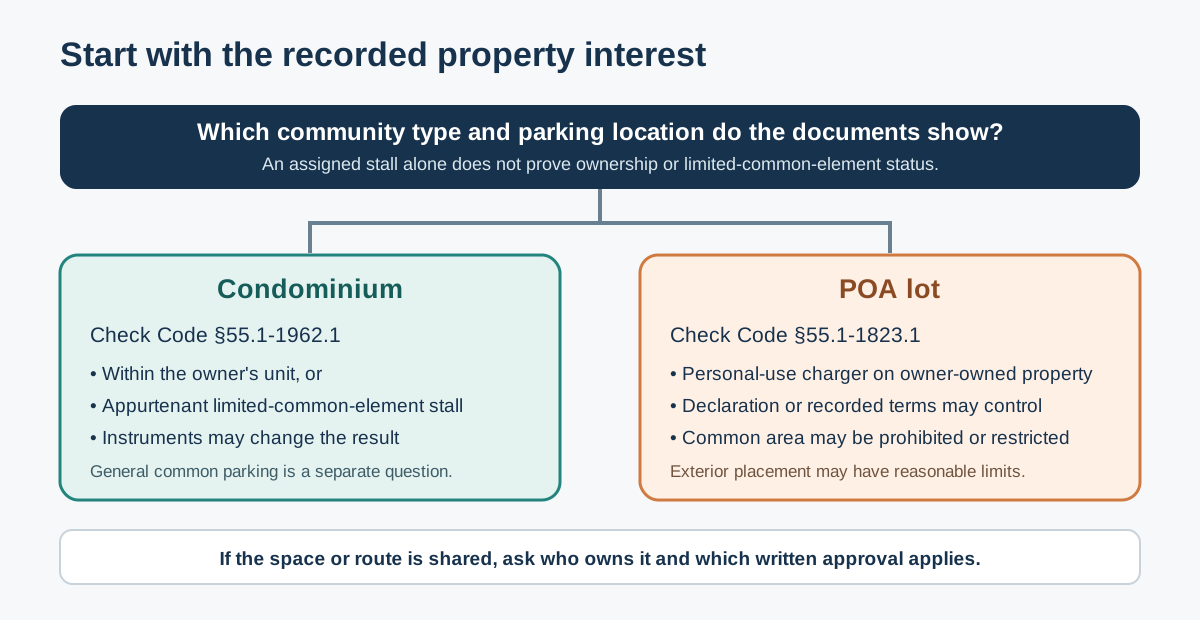
If the property is a condominium
Under Code §55.1-1962.1, unless the condominium instruments provide otherwise, an association may not prohibit an owner from installing a personal-use charging station within the unit or on a limited common-element parking space appurtenant to that unit. The space must fit the statutory property description. A stall that is merely assigned or used by the owner may need a closer document review.
The association may prohibit a proposed installation when it is not technically feasible or reasonably practicable because of a safety risk, structural issue, or engineering condition. It may set reasonable approval conditions described in the statute, including requirements about plans, applicable codes, architectural standards, qualified installation, owner-paid costs, metering, insurance, indemnity, removal, restoration, or reimbursement of attributable common expenses. Some installation conditions run with title in the circumstances stated by the law. Ask the association to identify the document or condition it relies on, and get a qualified professional to assess engineering or safety concerns.
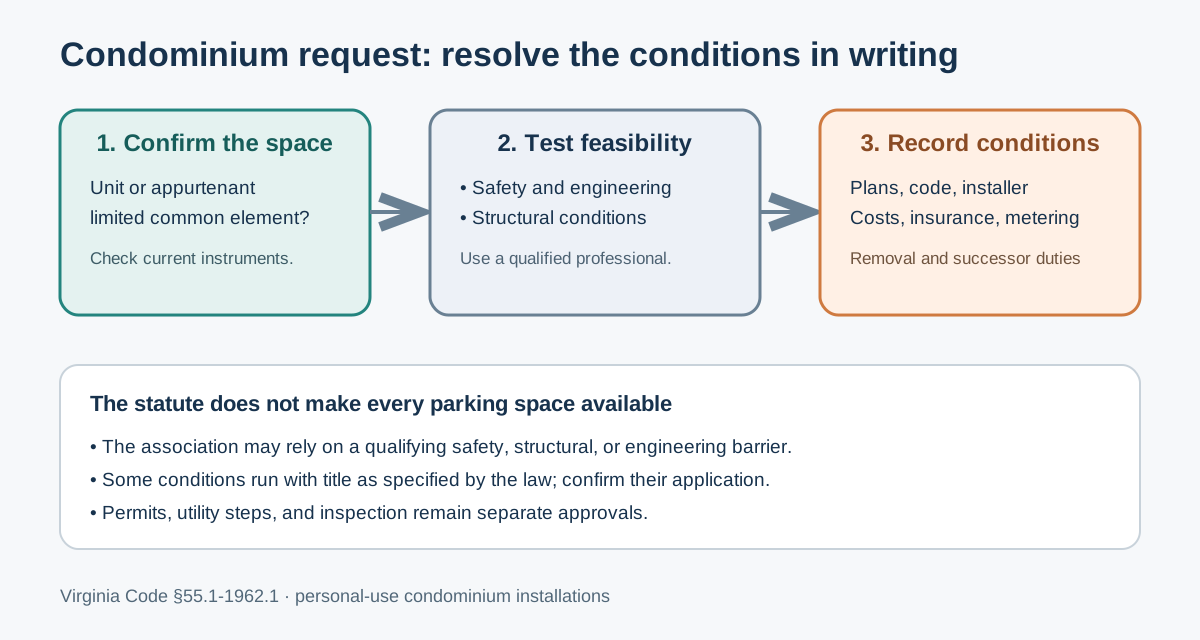
This section does not establish a general right to install in unassigned common parking. Ask the association which application and written approval are required for the precise location before commissioning work.
If the property is in a POA
Code §55.1-1823.1 addresses a personal-use charging station installed on property the lot owner owns, unless the declaration or another recorded governing document provides otherwise. The association may impose reasonable restrictions on the number, size, location, and manner of exterior placement. The statute separately allows a POA to prohibit or restrict equipment in association common areas. It does not make a common parking stall available to an individual owner.
An installing owner must indemnify the association for claims arising from installation, maintenance, operation, or use. The association may also require insurance and may require itself to be named as an insured. The section does not state a general response deadline. Confirm the current declaration, any recorded placement terms, insurance conditions, and the association’s actual written request process.
Prepare a decision-ready request
For the branch that fits your property, send a concise written package with:
- Property evidence: the relevant deed or declaration pages, parking designation, stall location, and proof of the right to use it.
- A defined proposal: charger location, preliminary cable route, equipment type, and whether work touches common elements or shared electrical rooms.
- Professional review: a qualified local electrician’s feasibility assessment, proposed load or metering approach, and installer credentials. Label drawings preliminary until the building and utility confirm requirements.
- Responsibilities: who pays for installation, electricity, insurance, maintenance, damage, removal, and restoration, and what duties continue if the unit or lot is sold.
- Remaining approvals: the association’s written decision, local electrical or building permits, utility requirements, and inspection or closeout steps.
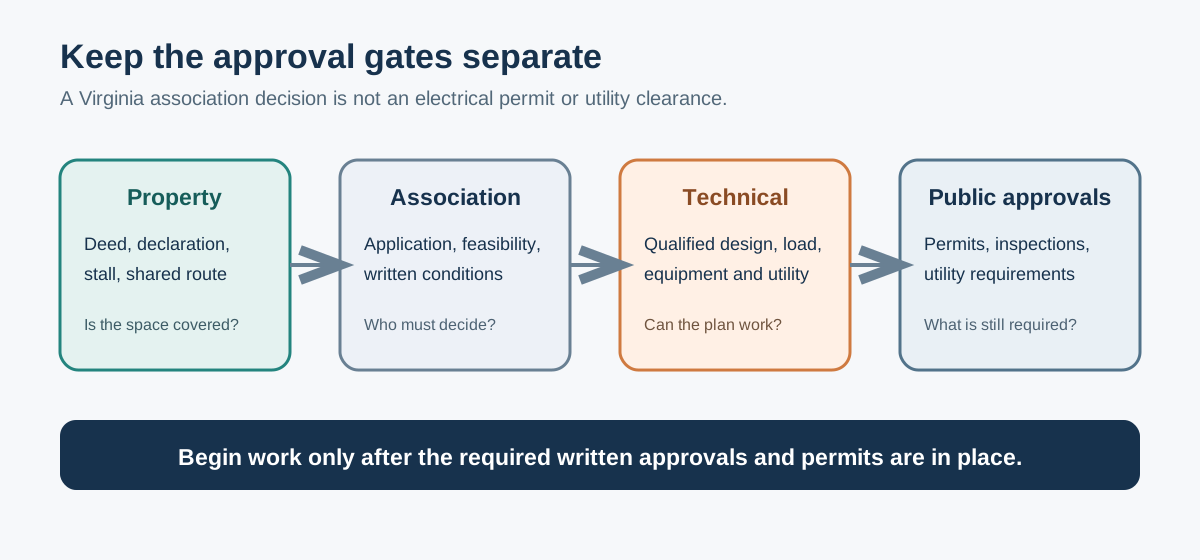
Keep the response, plans, insurance documents, permits, and final inspection records together. If the association’s decision turns on ownership, technical feasibility, or the meaning of a recorded document, pause and get advice from a Virginia lawyer or qualified professional. A community approval does not replace a permit, utility approval, or electrical inspection.
For a reusable board package, see the condo, HOA, or strata proposal guide. For address-specific public approvals, use the local rules and permits workflow. North Dakota’s separate condominium process is summarized in the North Dakota request guide; its application and parking rules do not transfer to Virginia.