If the building is served by UK Power Networks, start with the landlord or managing agent and a qualified electrical contractor. Identify who is responsible for the shared building network, then confirm with UKPN which connection route fits the proposed work. A distributor application concerns UKPN’s network; it does not assess or approve the internal EV installation or show how much capacity a particular block has.
This guide is limited to a UKPN-served multi-occupied building in its service area. It is not a UK-wide or Northern Ireland process. If the serving distributor is uncertain, confirm it before using these steps.
Keep the responsibilities separate
“The building supply” can mean several connected but different things. UKPN’s multi-occupied-building guidance describes the landlord, building-network operator, contractor, and distributor handoff. Check the actual equipment boundary and ownership against property records and with the responsible parties; do not infer them from a meter label or the building’s age.
| Question | Contact to identify | What that contact does not settle by itself |
|---|---|---|
| Who operates the local distribution network and handles a request to change its connection? | The serving DNO; for this guide, confirm whether it is UK Power Networks. | It does not establish the design or condition of the property’s internal wiring. |
| Who owns or maintains the shared building network? | The BNO, which may be a landlord, building manager, another network operator, or in some cases the DNO. | The BNO role does not automatically identify the electricity supplier, account holder, meter arrangement, or who pays for EV electricity. |
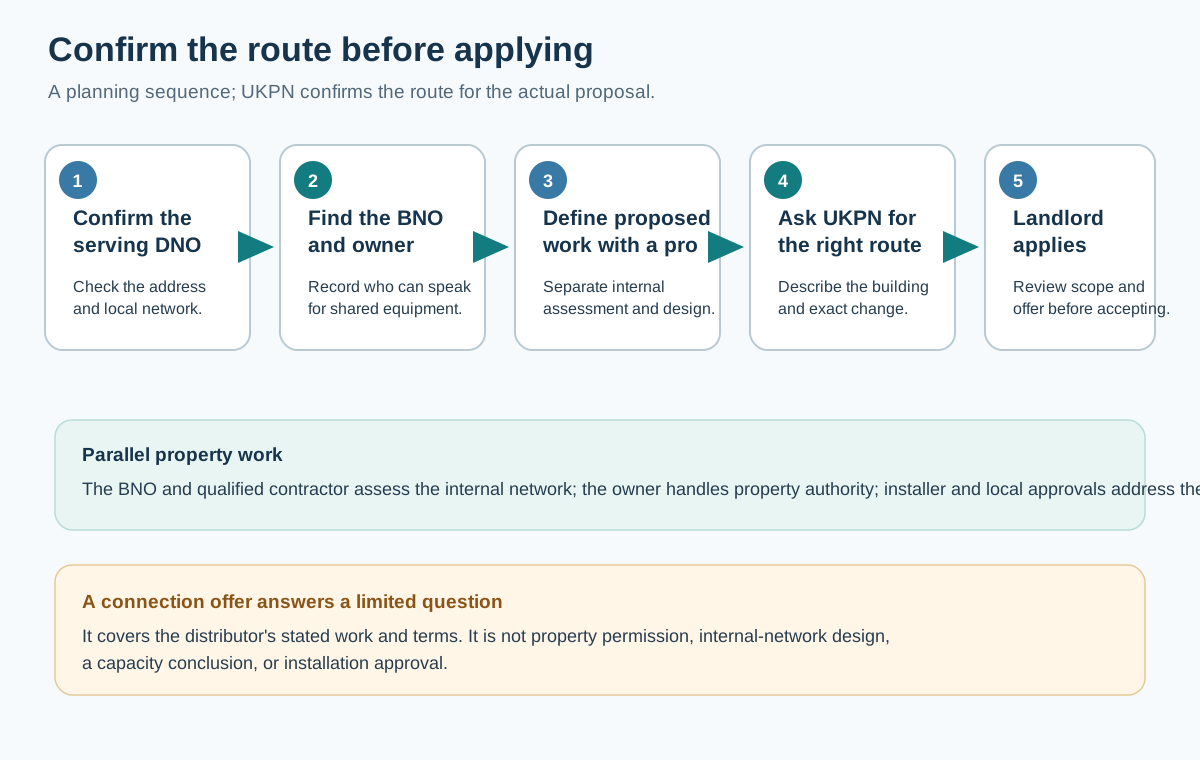
| Who assesses the internal network and proposed EV supply? | The building’s BNO or owner working with a suitably qualified electrical contractor. | A DNO connection quotation does not certify internal capacity, design, or installation. |
| Who approves work at the property and manages its installation? | The landlord, managing agent, or other authorized property decision-maker, with the installer and relevant authorities. | A utility application is not property permission, a permit, or an installation approval. |
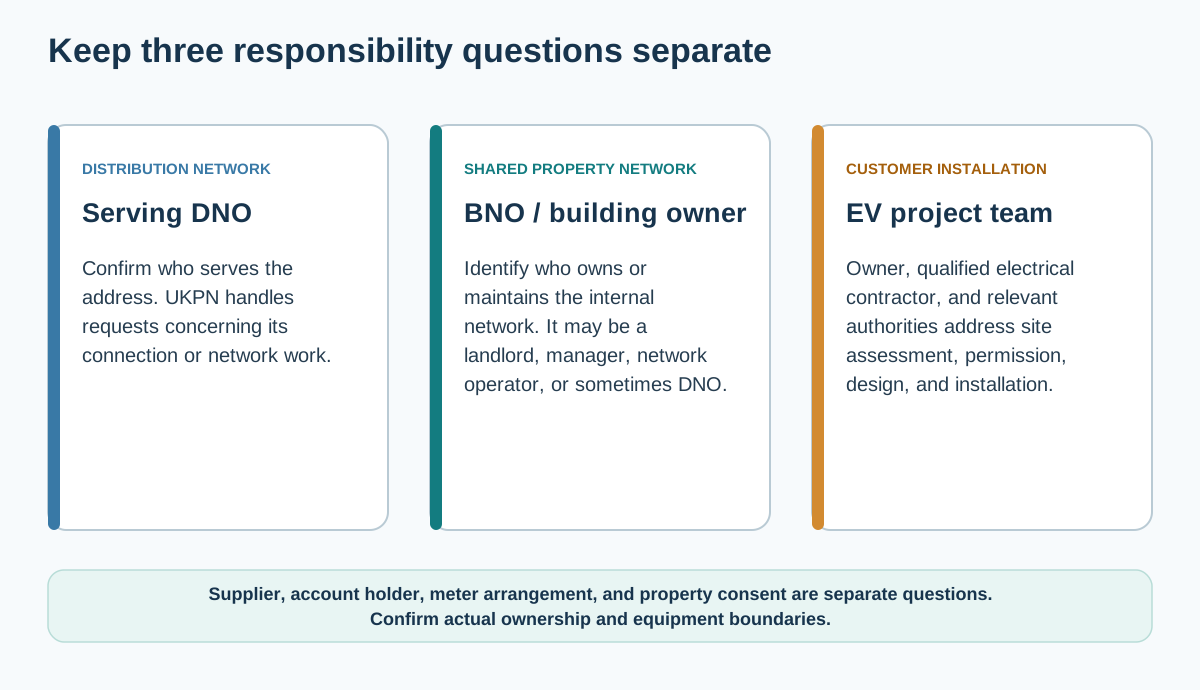
UKPN’s BNO Guide describes the building network as the internal electrical network serving premises from the intake position. It says the BNO is responsible for the network arrangement, which must be designed, installed, and maintained under applicable requirements including BS 7671. UKPN says it does not approve that internal network design under BS 7671. Have the BNO and qualified electrical team establish the actual scope and responsibility rather than asking UKPN’s connection team to sign off internal design.
Prepare the building-side handoff
Before choosing a route or asking for a price, the landlord or managing agent can assemble a short brief with the BNO and electrical contractor:
- Building address and confirmation of the serving distributor, if known.
- The person authorized to make a property or utility application and the BNO or network-owner contact; record uncertainty if ownership is unknown.
- Available records for the existing service and internal network, including drawings or previous connection correspondence. Note missing or outdated documents rather than treating them as current.
- Where charging is proposed, which parking areas and shared spaces are involved, and the number and kind of users the project hopes to serve.
- The electrical contractor’s description of the question being assessed and proposed work. Keep a building-capacity assessment, DNO connection request, internal design, and installation as separate scopes.
- Open questions: who owns the equipment, what supply change is requested, who will assess the internal network, and what approvals or property permissions remain.
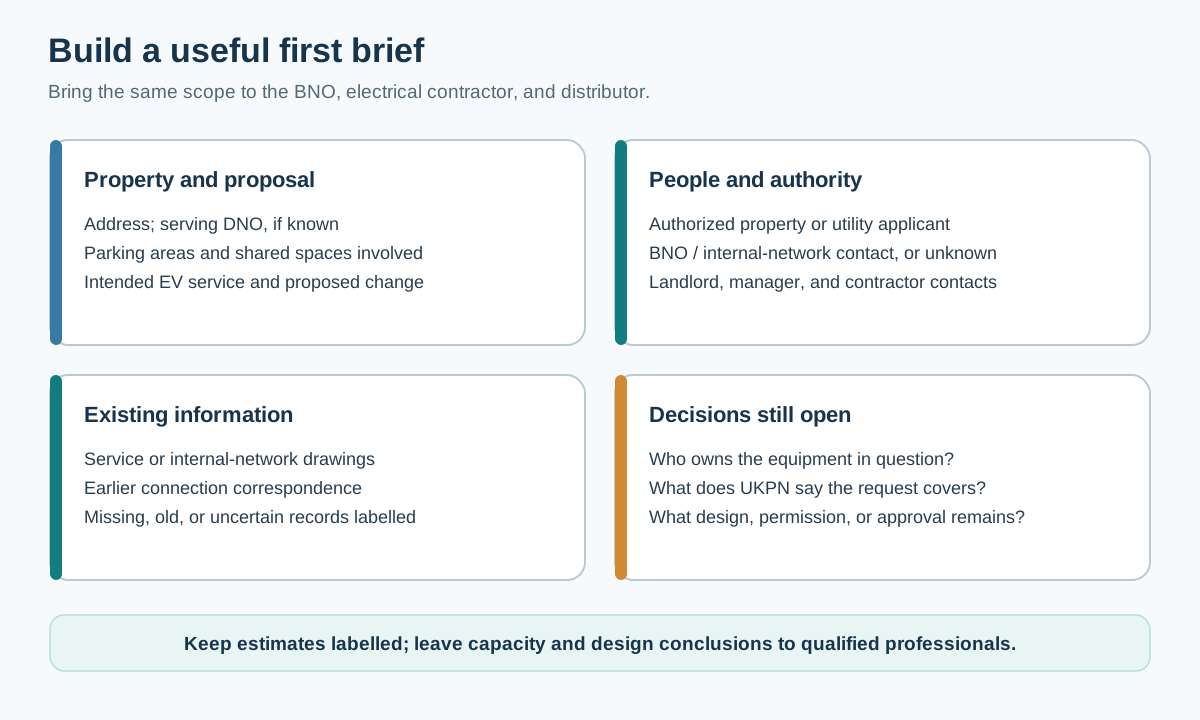
Residents can pass this brief to the building owner or manager. UKPN’s business EV guidance directs people planning an installation in a multi-occupied building, such as a block of flats, to contact the building owner first. A domestic charger route does not give permission to work on shared equipment or common areas.
Ask UKPN which connection route applies
UKPN’s multi-occupied-building connection process says this kind of connection commonly involves a new connection or an upgrade to an existing one, and recommends asking the BNO or electrical contractor what is needed. That general description does not mean every existing block or EV retrofit needs a new supply. First state whether the proposal may alter the building connection or is limited to the internal network, then ask UKPN to confirm its process for the specific project.
For its multi-occupied-building process, UKPN says the landlord should submit the application. If the BNO is unknown, UKPN says it can confirm equipment ownership as part of that application. After reviewing the request, UKPN sends a price for the service it will provide; if the offer is accepted and paid, UKPN can book its work. Check what the offer covers and what separate internal assessment, installation, or approval work remains.
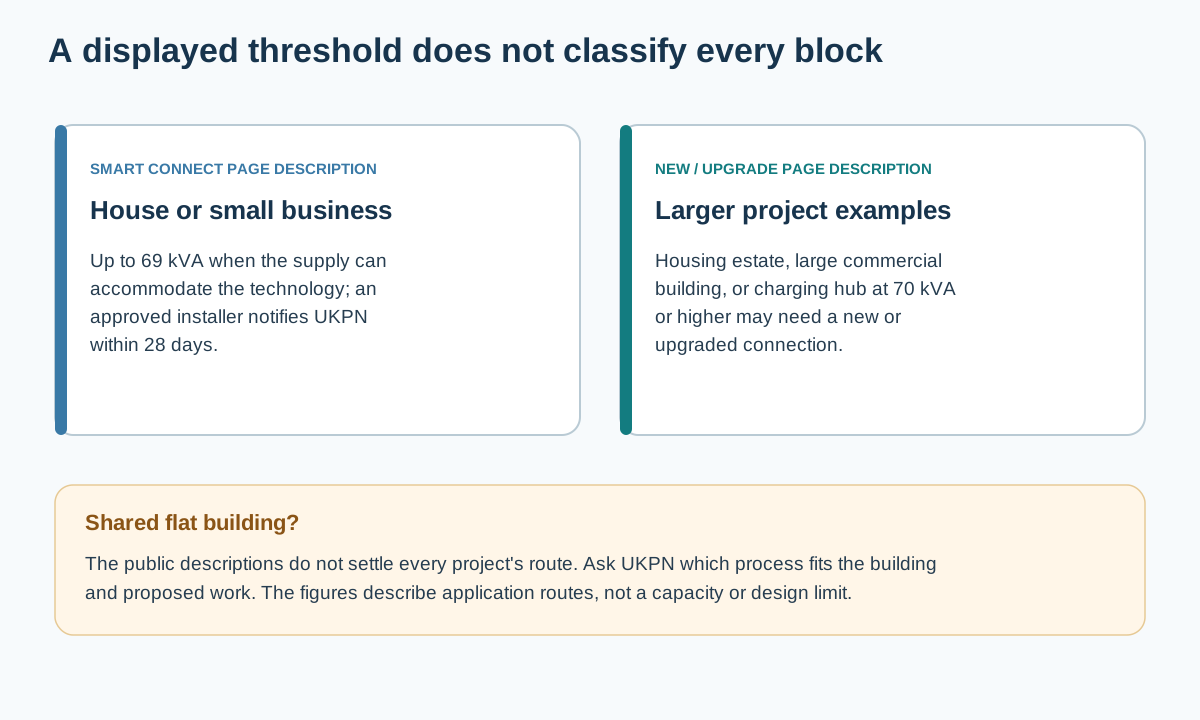
Do not infer shared-block eligibility from a domestic route
UKPN’s Smart Connect page describes an approved-installer notification route for a house or small business up to 69 kVA, where the supply can accommodate the low-carbon technology, with notification within 28 days. The same page describes larger projects such as a housing estate, large commercial building, or charging hub at 70 kVA or higher as projects that may need a new connection or upgrade. These are descriptions of UKPN’s routes; they are not capacity limits or design rules for an apartment building.
The public page does not establish how every shared-flat EV project is classified. Do not assume a building can use Smart Connect because it is residential or because an early estimate falls below a displayed figure. Ask UKPN which route applies to the exact building and proposed work. An installer notification, where available, does not replace the BNO’s internal-network assessment, property permission, or the required installation checks.
Leave with a written decision brief
Keep a short record that says:
- Which distributor serves the property and who confirmed it.
- Who the BNO or internal-network owner is, or what remains unknown.
- Who is authorized to apply and which UKPN route UKPN says to use.
- What the contractor will assess inside the building and which records are still missing.
- What any UKPN quotation covers, what internal work remains separate, and who is responsible for property consent and next approvals.
These answers organize the handoff; they do not establish available capacity, charger count, cost, wiring, or permission to install. For the general records packet, see the apartment building capacity assessment. Compare system and account arrangements in unit meters, common meters, and submeters, or compare options in service upgrades versus load management. Check local EV charger rules and approvals and use the apartment installation guide for the later property and delivery steps.