A kWh value in a charger app or building dashboard does not by itself show that the equipment and transaction are accepted for billing. Before charging residents by measured energy, identify the transaction, find the state or local weights-and-measures authority and adopted requirements, and request approval and inspection evidence for the exact device and software. The answer depends on where the building is, what the customer is paying for, and how the charging system measures and records the amount.
This guide gives operators a verification route. It does not decide whether a particular building may charge a fee or which law applies to an unspecified site.
Describe the actual transaction
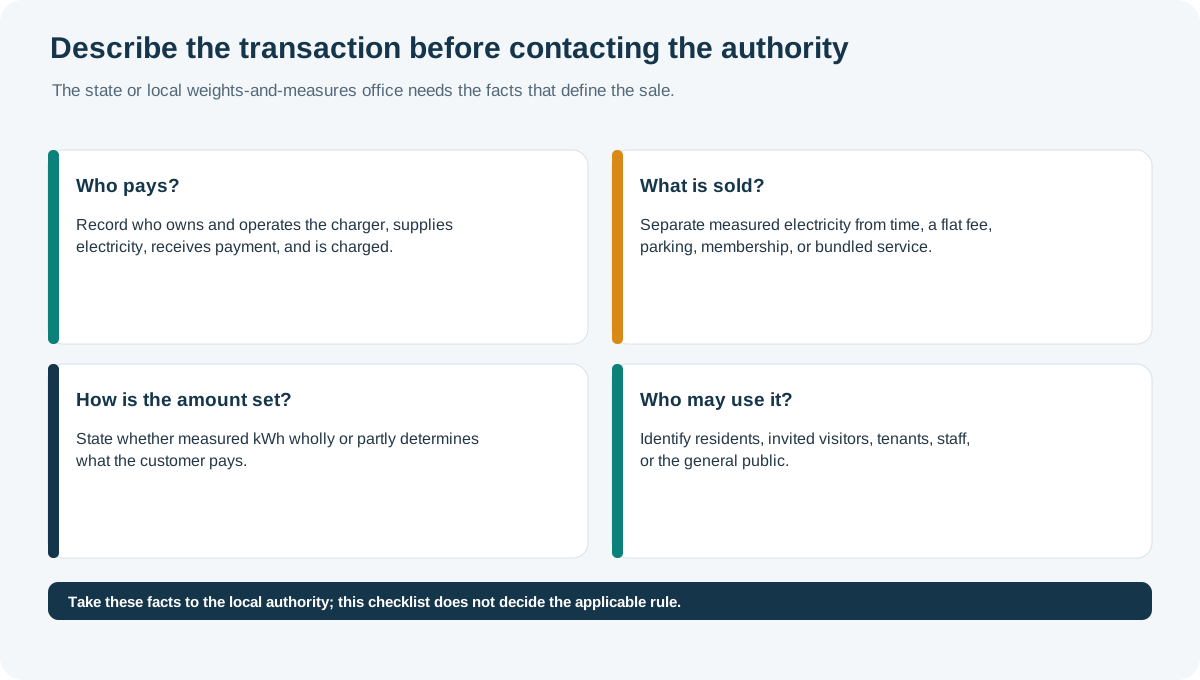
Write down the facts before asking a supplier for a compliance statement:
- Who owns and operates each charger, supplies the electricity, sets the charge, receives payment, and handles a dispute?
- Is the customer paying for measured electricity, charging time, a flat session fee, parking, membership, or a bundle of services?
- Is the measured kWh quantity wholly or partly used to calculate what the customer pays?
- Who can use the stations: residents and invited visitors, tenants, staff, or the general public?
- Which parts of the amount are energy, time, parking, tax, payment processing, or another service fee?
Ask the state or local weights-and-measures office how those facts affect the applicable rule. Do not assume that calling a charge “reimbursement,” a common expense, or a service fee settles the classification. NIST’s EV-fueling FAQ explains that states can allow different methods of sale, including kWh, time, or a flat amount; confirm which options and disclosure requirements apply where the property operates.
Find the adopted rule and responsible authority
NIST Handbook 44 is a model code. The 2026 edition includes Section 3.40 for electric vehicle fueling systems. That section addresses EVSE when measured electricity is wholly or partly the basis for a sale or charge for service, and it includes defined exceptions. Its text is a starting point for the question, not proof that the same edition or wording has been adopted in every state or locality.
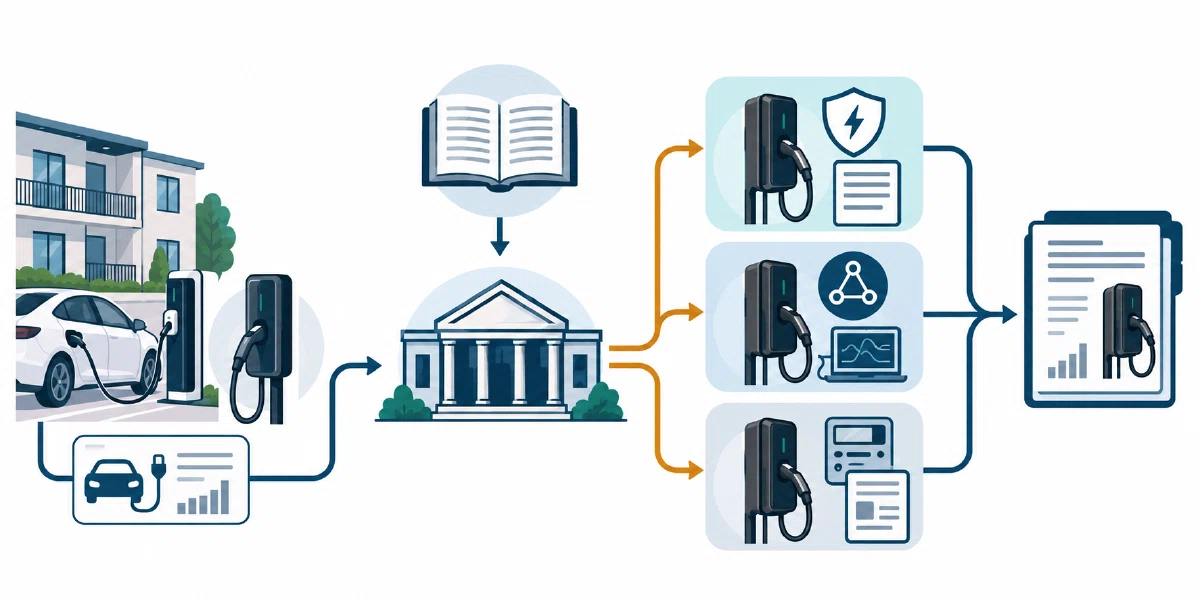
Use NIST’s state weights-and-measures director directory to find the appropriate office. Ask the authority to identify the currently adopted code edition, state amendments, local requirements, accepted device-approval route, registration rules, inspection process, and records required for this transaction. Keep the answer with the project file. If a question turns on a contract, condominium arrangement, utility rule, or consumer law, get advice from a qualified professional in that jurisdiction.
Verify the exact device and its approval status
Ask the supplier for the manufacturer, full model and variant, charging port or meter identity, measurement function, software and firmware versions, and the approval or type-evaluation record that covers that exact configuration. Then confirm the record with the relevant authority or official listing. Ask whether the device is registered at the property, whether a field inspection or seal is required, and whether that inspection has been completed.
Keep the evidence types separate. Electrical safety certification addresses product safety. OCPP testing addresses protocol behavior between charging equipment and management software. Type evaluation addresses whether a measuring device meets applicable measurement requirements. One certificate does not answer the others, and a supplier’s statement that a family of products is covered should be checked against the listed model and certificate conditions.
The 2026 Handbook 44 model text describes NTEP type evaluation for EVSE and says an EVSE can be evaluated only when it conforms to the code and has the required electrical safety certification. Ask the local authority which route it accepts and whether that route applies to this device and transaction; do not assume every state requires both an NTEP certificate and a separate state approval.
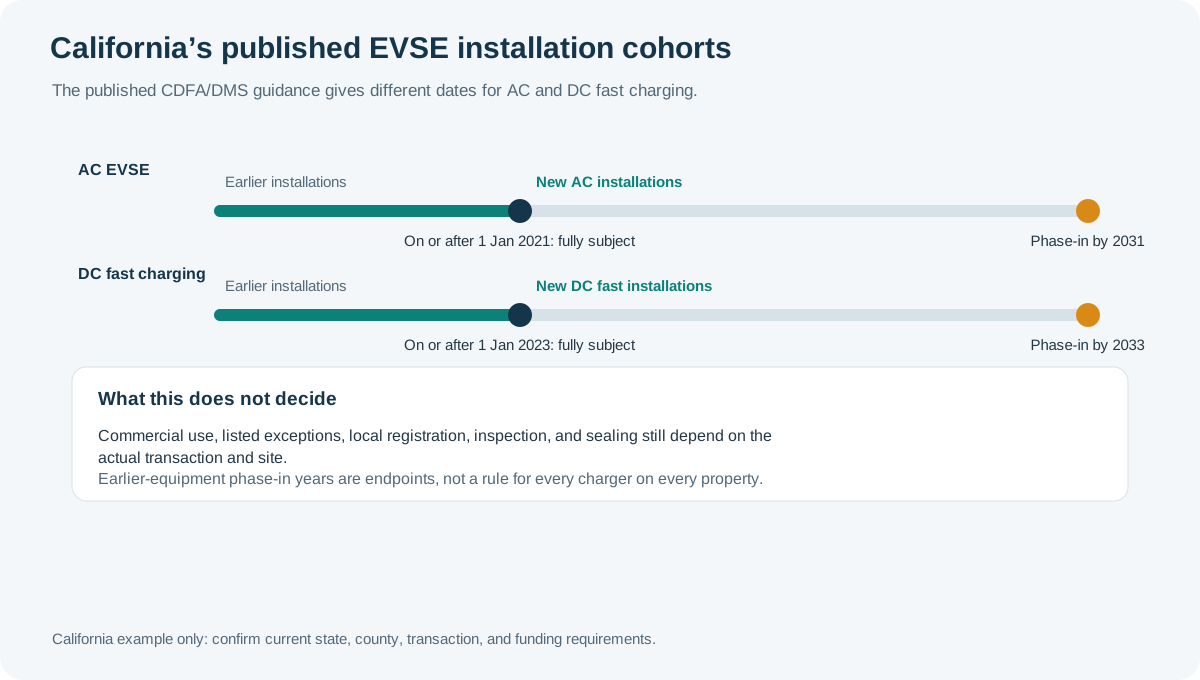
California illustrates why the authority and installation details matter. The California Department of Food and Agriculture’s Division of Measurement Standards says commercial EVSE selling electricity as motor-vehicle fuel for a fee are generally within its program, with listed exceptions that include specified utility or public-entity activity, noncommercial use, no-cost charging, and wholesale transactions. Its guidance describes type evaluation through CTEP or NTEP, registration of commercial retail devices with the local county weights-and-measures office, and county field inspection, testing, and sealing. The published schedule says new commercial AC EVSE installed on or after 1 January 2021 and new DC fast chargers installed on or after 1 January 2023 are fully subject; earlier equipment is phased in by 2031 for AC and 2033 for DC fast charging. This is a California example, not a rule for another state or a decision about a particular apartment transaction. Confirm current state and county requirements for the actual project.
Reconcile the measured amount from charger to receipt
Ask the vendor and operator to demonstrate one session from the device’s measurement through the charging-management system, price calculation, invoice, and resident receipt. Record the exact software versions and data fields involved. Include a completed session, a failed or interrupted session, a correction or refund, and a change to the price or configuration.
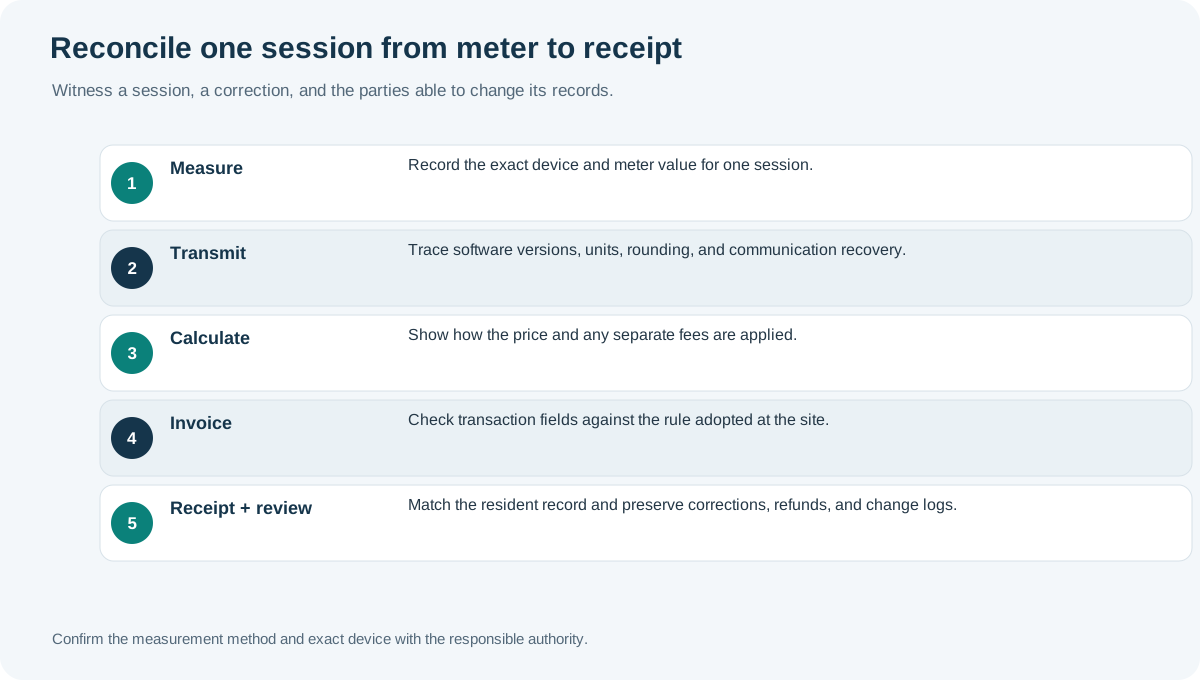
The NIST model text provides useful questions for the authority and vendor. If the adopted rule follows those provisions, confirm how the system:
- identifies the energy unit, measured amount, unit price, and total amount due;
- shows energy charges separately from time-based or other fees;
- supplies a transaction receipt with the required business, location, station, and price information;
- records an interruption and preserves transaction information after loss of power or communications;
- prevents a missing, duplicated, rounded, or edited data record from silently changing the amount billed.
Ask who can change meter-related settings, firmware, tariffs, or transaction records, and how each change is logged and reviewed. If communications fail, determine whether the transaction can still be completed under the local rule, whether billing stops, and how residents can obtain a corrected record. Do not treat a backend kWh field as the legally relevant measurement without confirmation from the authority and evidence for the exact device.
Signed meter data can help protect a station-to-CSMS transfer, but it does not by itself establish that the device is approved for the transaction, that the billing system received a complete record, or that the invoice and resident receipt are correct. Trace the exact reading through any conversion, correction, unit price, and final amount. Likewise, if the system uses a control limit, keep its command acknowledgement or configured setpoint distinct from the applicable measured energy used in the charge. The Open Charge Alliance’s signed-meter specification describes station-to-CSMS transport; use it as technical context, not as a U.S. measurement rule.
Keep a reviewable evidence file
Before the first resident charge based on measured energy, retain:
- The transaction description and the authority’s guidance on the applicable adopted requirements.
- The exact charger, meter, port, software, and firmware identifiers.
- The accepted type-evaluation or approval record and any conditions or product-family scope.
- Current registration, inspection, testing, and sealing records where required.
- A witnessed session record showing the measurement, fee calculation, receipt, and interruption or correction path.
- The responsible party, dispute contact, record-retention owner, and process for reviewing a device, software, network, or billing-model change.
Recheck the approval and billing path after a device, firmware, backend, meter, price calculation, ownership, or transaction changes. For the building’s connectivity and data handoff, see networked EVSE requirements. Rate setting and cost allocation are separate decisions; the Canadian kWh approval guide describes a different national process.
Checked: 9 November 2026. Confirm the adopted rule, current device records, and transaction-specific requirements with the relevant state or local authority before billing residents by measured energy.